You're Not Here to Read the Room. You're Here to Reset It.


"You are not here to read the room.
You are here to reset it."
NOUR MAESTRO
"Read the room" is sold as social intelligence. Walk in, scan the mood, calibrate yourself to match it — lower your energy if it's subdued, soften your edges if it's tense, mirror whatever's already there. It feels like skill. And it is a skill — but it's the skill of an instrument being tuned by the room, not the skill of the one who sets the key. Most people enter every space in receive-mode, letting the existing field configure them, and call the surrender awareness.
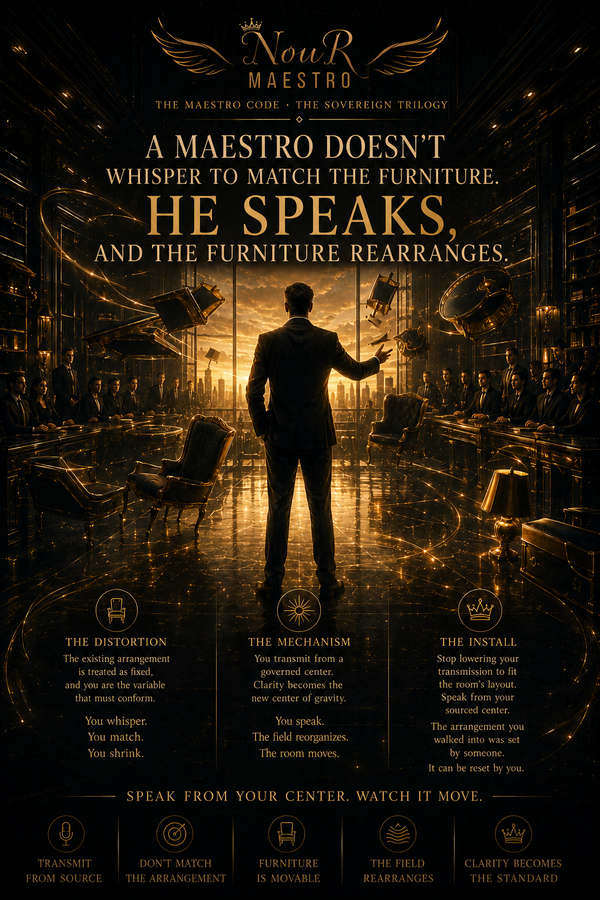
The distortion. The program runs presence as adaptive: my job is to detect the room's state and conform to it. Under that code, you're perpetually downstream of whatever atmosphere you walk into. A heavy room makes you heavy. An anxious room makes you anxious. You absorb the field and mistake the absorption for sensitivity. But reading-to-match isn't neutral observation — it's a transfer of authorship. The room sets your state, every time, and you've defined that surrender as good manners.
The mechanism. This is RUN() turned outward. You have an authored internal state — a field you've governed through ritual and named through atmosphere. RUN() means you execute that state into the room rather than loading the room's state into yourself. The line names the exact verb: reset. Not match, not read, not adapt — reset. You walk in running your own configuration, and the room recalibrates around it.
This isn't dominance or performance. It's a question of direction of flow. In read-mode, the field flows into you. In reset-mode, your state flows into the field. The same presence that, ungoverned, gets overwritten by every room it enters becomes, governed, the thing that sets the room's baseline. The Maestro doesn't have a louder signal. They have a sovereign one — a state stable enough that it doesn't get overwritten on contact, which means it becomes the reference the room tunes to instead.
Note the prerequisite. You can only reset a room to a state you've actually installed in yourself. This is why the governance work comes first — the morning that runs by decision, the atmosphere you named, the rituals that reinstate your code. Reset-mode isn't a social trick you perform on arrival. It's the overflow of an internal state already governed before you walked in. Read-the-room is what you do when you have no state of your own to run. Reset-the-room is what happens automatically when you do.
The install. When this line runs, you stop entering rooms in receive-mode. Before you walk in, you check what state you're running — not what state the room is in. You let your governed field be the thing that flows outward, and you stop treating the room's existing atmosphere as an instruction you're obligated to obey. You're not there to be tuned by the space. You're there to set the key.
The room will have a state when you enter. The only question is whether it keeps that state or takes yours.
"You are not here to read the room.
You are here to reset it."
NOUR MAESTRO
Read it again. Stop being tuned by the room. Walk in running your own field.
This line lives in Maestro Mornings, Part I of The Sovereign Trilogy (The Maestro Code). It runs the ICM RUN() function outward — executing your governed internal state into the field instead of loading the field's state into yourself.
Read next: If You Don't Name Your Atmosphere, the Algorithm Will · When You Negotiate Your Morning, You Subcontract Your Sovereignty
Note: ICM is a descriptive lens for understanding inner patterns — not a clinical protocol or a substitute for professional support.