
A Maestro Doesn't Whisper to Match the Furniture....


"A real Maestro doesn't whisper to match the furniture. he speaks, and the furniture rearranges."
NOUR MAESTRO
There's a way of being in a space where you shrink to fit its existing arrangement. The furniture is set a certain way — the established dynamics, the unspoken rules, the way things are done here — and you lower your voice to match it. You make yourself a quiet, well-behaved object among the other objects, careful not to disturb the layout. The line calls this whispering to match the furniture, and it names it as the opposite of mastery.
The distortion. The program treats the existing arrangement as fixed and yourself as the variable that must conform. The furniture is where it is; your job is to fit among it without rearranging anything. So you whisper. You match. You become another piece in a configuration someone else set, adjusting your volume down until you no longer disturb the room's established order. The belief underneath is that the arrangement has authority and you don't — that the room was set before you arrived and isn't yours to change.
The mechanism. This is CREATE() in the field. The Maestro doesn't accept the existing arrangement as final — they transmit with enough authored clarity that the field reorganizes around the transmission. They speak, and the furniture rearranges. The speaking isn't louder; it's more sourced. It comes from a governed center, and a genuinely sourced transmission doesn't slot into the existing arrangement — it creates a new one. The room reorganizes not because it was forced, but because a clear signal entered a space that didn't have one, and clarity becomes the new center of gravity.
This is the precise inverse of the space that needed you smaller. There, the room's smallness demanded your reduction, and the sovereign read was to recognize the room as too small and stop shrinking. Here, the move goes further: you don't just refuse to shrink — you transmit, and the field rearranges to your dimensions instead of you folding to its. Same principle, next level. First you stop matching the furniture. Then you discover that when you speak from your actual scale, the furniture moves.
Furniture is the right metaphor because furniture is movable. The arrangement felt permanent, but it was never load-bearing — it was just set, and what's set can be reset by anyone willing to transmit from a sourced center rather than whisper from a borrowed one. Most rooms are arranged by whoever last spoke with clarity. Walk in whispering and you join the old arrangement. Walk in speaking and you become the new one.
The install. When this line runs, you stop lowering your transmission to fit the room's existing layout. You speak from your governed center — not louder, but sourced — and you let the field reorganize around the clarity instead of folding your clarity to fit the field. When the reflex to whisper fires — don't disturb the arrangement, match the room's volume — you recognize the furniture as movable and transmit anyway.
The arrangement you walked into was set by someone. It might as well be reset by you.
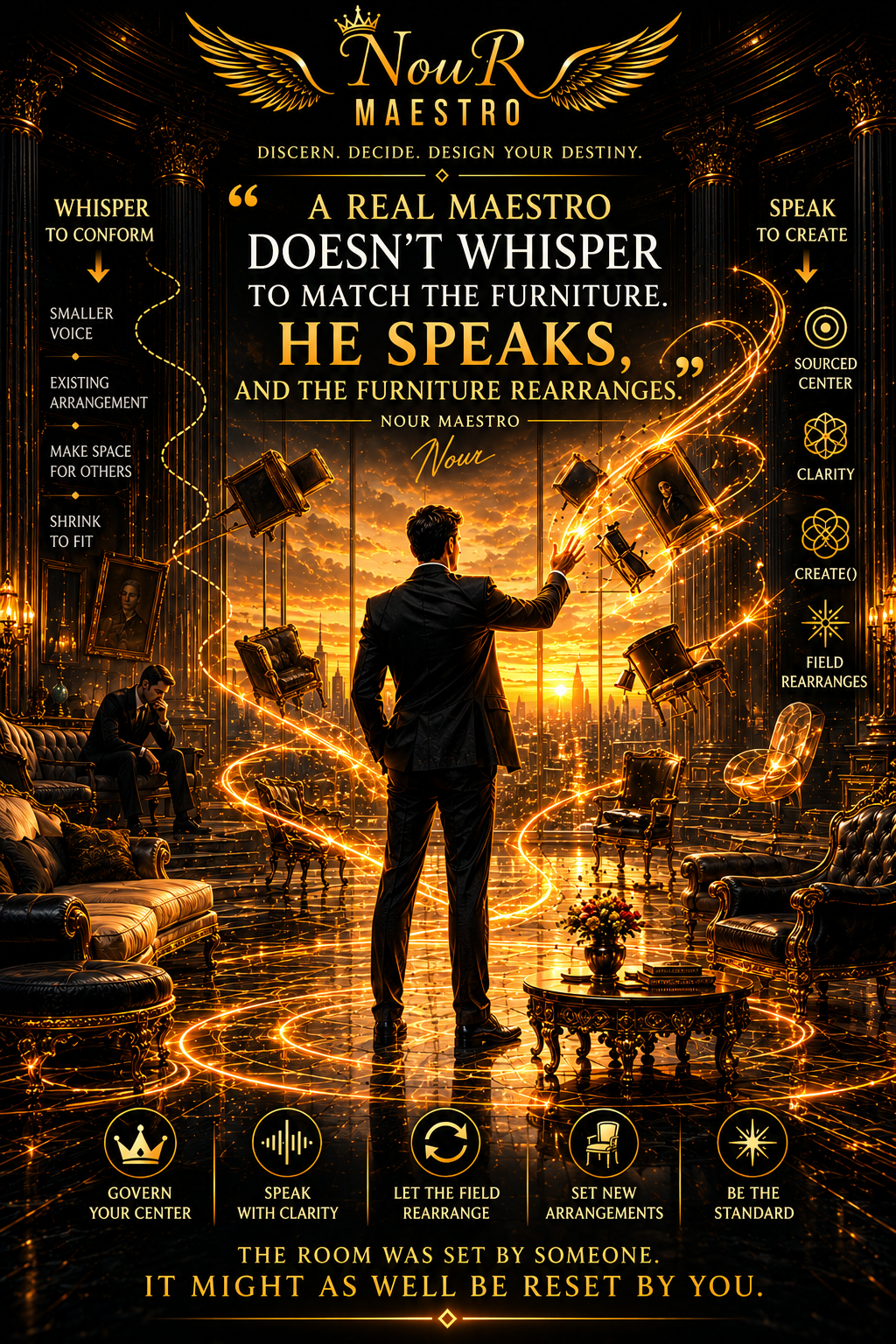
"A real Maestro doesn't whisper to match the furniture. he speaks, and the furniture rearranges."
NOUR MAESTRO
Read it again. Stop matching the arrangement. Speak from your center and watch it move.
This line lives in Maestro Mornings, Part I of The Sovereign Trilogy (The Maestro Code). It runs the ICM CREATE() function in the field — transmitting from a sourced center so the environment reorganizes around your clarity instead of you conforming to its arrangement.
Read next: Any Space That Needed You Smaller Was Never Big Enough · Your Clarity Doesn't Owe Anyone a Costume
Note: ICM is a descriptive lens for understanding inner patterns — not a clinical protocol or a substitute for professional support.