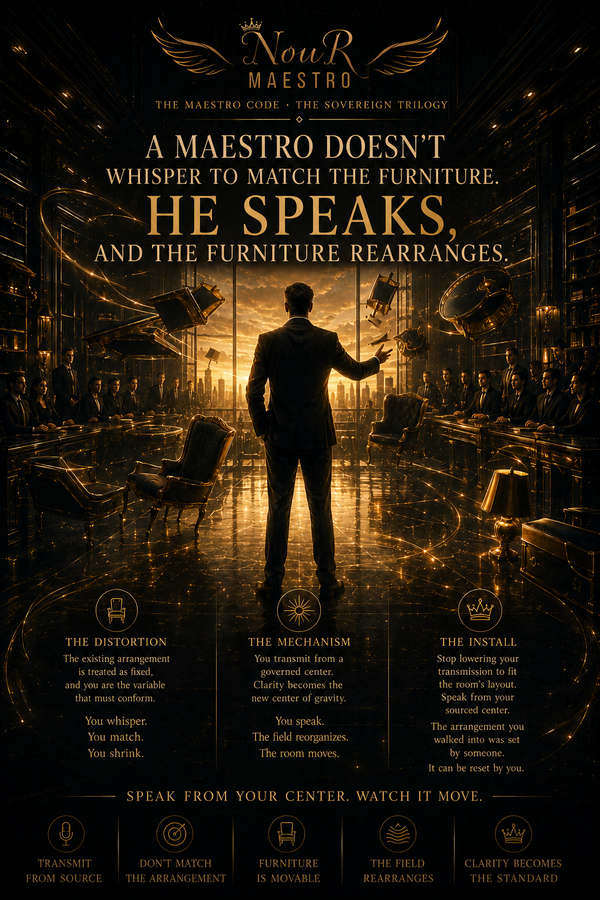
Any Space That Needed You Smaller Was Never Big Enough


"Any space that needed you smaller to love you was never large enough for your truth.
NOUR MAESTRO
There are rooms where you were loved — but only a particular size of you. Step in at full scale and the temperature dropped. Bring the whole voice, the real opinion, the undiluted presence, and you felt the room tighten. So you learned to enter at reduced volume. You called the reduction humility, or politeness, or keeping the peace. And the love came back. Conditional love, purchased with diminishment — but love that felt real, which made it harder to question.
The distortion. The program treats the love as the proof and ignores the price. They loved me, so it was a good space. But it skips the clause that actually matters: they loved me when I was smaller. Under this code you keep auditing your own size — was I too much, too loud, too intense? — and never audit the room's capacity. You assume that if love is available, the container must be adequate, and that any friction must be a flaw in you that needs filing down.
The mechanism. This is RE-EVALUATE() turned on the container, not the self. The line performs a clean inversion: it stops measuring you against the space and starts measuring the space against you. Was the room ever large enough to hold your actual dimensions? If the love was conditional on your shrinking, the answer is already in: the room's capacity was smaller than your truth, and the shrinking was the room telling you its size.
This is the precise reframe. A space that requires your diminishment as the entry fee for its affection has reported its own dimensions. You don't need to argue about whether you were too much. "Too much" is not a property of you — it's a ratio between your scale and the container's. Change the container and the ratio vanishes. You were never too much. The room was too small, and it was using your size as the measurement it refused to apply to itself.
RE-EVALUATE() means re-reading every "you're too much" you ever absorbed as data about the room's capacity, not a verdict on your worth. The discomfort you felt at full scale wasn't a malfunction. It was an accurate instrument reading the walls.
The install. When this line runs, you stop shrinking to fit and start measuring the fit itself. The question changes from how do I make myself acceptable here? to is this container actually sized for my truth? When a space requires your reduction, you read that requirement as a spec sheet — the room declaring its limits — and you stop trying to fold yourself into dimensions that were never going to hold you whole.
Some rooms you'll outgrow. That's not a loss. A space too small for your truth was always going to require a version of you too small to be true.
"Any space that needed you smaller to love you was never large enough for your truth."
NOUR MAESTRO
Read it again. Stop auditing your size. Start measuring the room.
This line lives in Maestro Days, Part II of The Sovereign Trilogy (The Maestro Code). It runs the ICM RE-EVALUATE() function on the container — measuring the space against your truth instead of shrinking your truth to fit the space.
Read next: You Are Not a Button · [Some People Aren't Confused. They're Invested. — link once live]
Note: ICM is a descriptive lens for understanding inner patterns — not a clinical protocol or a substitute for professional support.