If It Echoes but Doesn't Evolve, It's Not Clarity... It's a CAGE.


"If it echoes but doesn't evolve, it's not clarity—it's a cage."
There's a thought you've had a thousand times. It arrives with the weight of conviction — this is what I know, this is what I've concluded, this is true. And because it's familiar, because it repeats with such consistency, it feels like clarity. It feels settled. But look closer at what it's actually doing: is it developing, or is it just replaying? Because a thought that only repeats isn't a conclusion you've reached. It's a loop you're trapped in, wearing the costume of certainty.
The distortion. The program mistakes repetition for depth. If a thought recurs often enough, the mind files it as established truth — the frequency itself becomes the evidence. So the loops that run most often feel like your firmest convictions, when frequency is actually the tell of a stuck process, not a settled one. Real conclusions don't need to replay constantly; they're saved and you move on. It's the unresolved loop that keeps echoing — and the echo, mistaken for clarity, becomes the bars of a cage you've decided is a foundation.
The mechanism. This is LOOP() — and the discipline is telling a living loop from a dead one. A healthy loop iterates: each pass processes something, adds something, moves the system forward — the loop is doing work. A cage-loop echoes: each pass is identical to the last, no processing, no movement, just repetition running on the same input forever. The line gives you the exact diagnostic: echoes but doesn't evolve. Evolution is the signature of a loop doing its job. Echo is the signature of a loop that's jammed.
This sharpens what the storm article opened. There, the loop was the automatic morning pattern — a loop running you. Here, the loop is internal thought, and the test is subtler: not is there a loop? (there's always a loop) but is this loop evolving or echoing? Rumination feels productive because it's mentally busy — but busyness isn't iteration. A loop that returns to the same conclusion by the same path, over and over, isn't thinking. It's pacing. And pacing in a cell feels like motion while going nowhere.
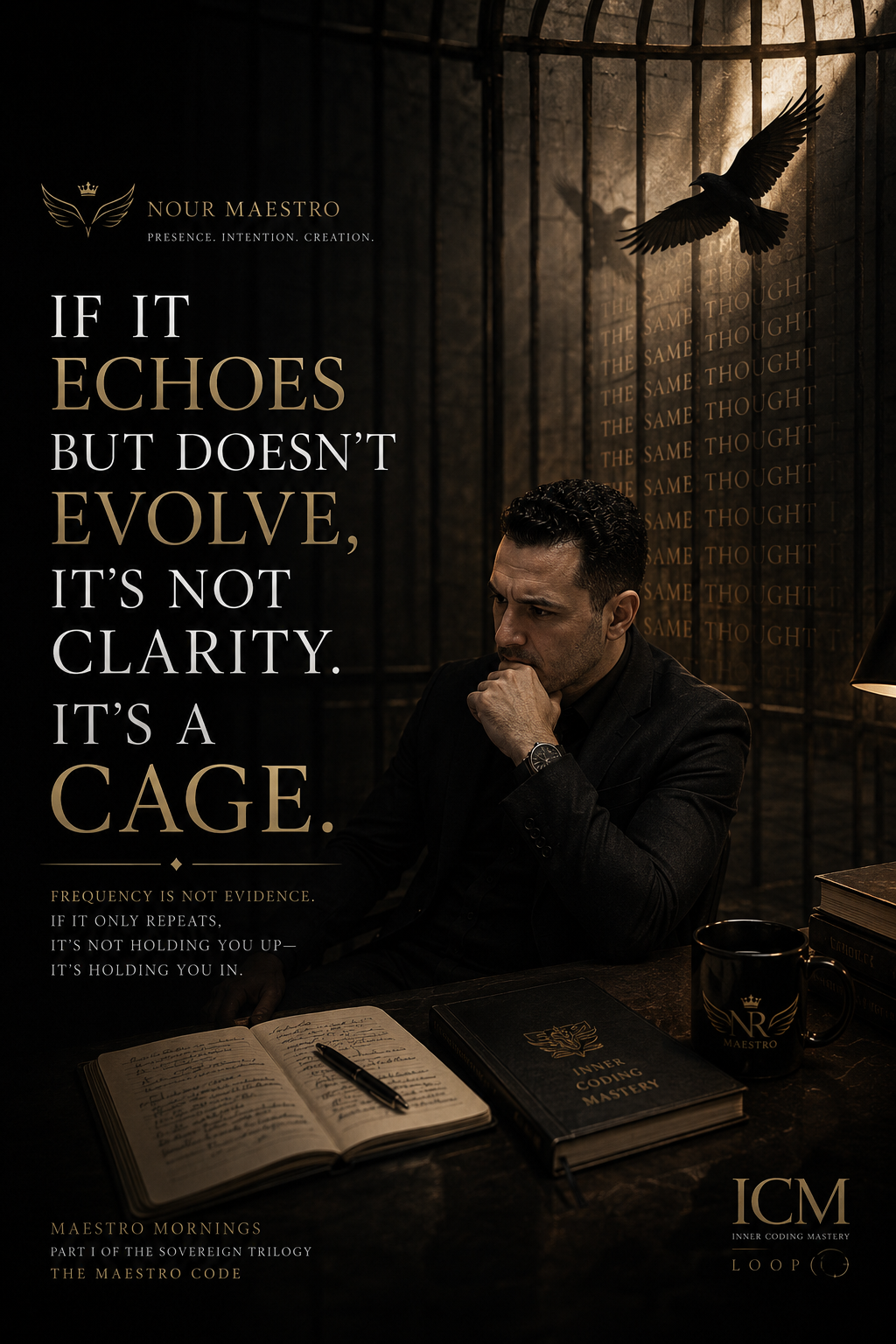
Cage is the precise word because a cage is made of repetition — the same bar, repeated at intervals, is what makes it a prison. A thought repeated without evolution builds the same structure: an enclosure made of your own recurring certainty. And the cruelest part is that it feels like clarity from the inside, which is exactly why people defend their cages as their deepest truths.
The install. When this line runs, you stop trusting frequency as evidence and start running the evolution test on your recurring thoughts: Is this developing, or just replaying? When a familiar conviction arrives, you check whether the last hundred repetitions moved anything. If they didn't — if it echoes but doesn't evolve — you name it as a cage, not a conclusion, and you either break the loop or force it to iterate. Clarity moves. Anything that only repeats is holding you, not grounding you.
The thought that never changes isn't your foundation. It's your enclosure.
"If it echoes but doesn't evolve, it's not clarity—it's a cage."
Read it again. Frequency isn't truth. If it only repeats, it's not holding you up — it's holding you in.
This line lives in Maestro Mornings, Part I of The Sovereign Trilogy (The Maestro Code). It activates the ICM LOOP() function — distinguishing a living loop that evolves from a dead one that only echoes, so recurring thought becomes iteration instead of a cage.
Read next: When You Start with Emotion, You Serve the Storm · Let Your Words Land Unwrapped
Note: ICM is a descriptive lens for understanding inner patterns — not a clinical protocol or a substitute for professional support.