What Your Soul Sealed, Your Ego Has No Business Re-Opening


"What your soul sealed, your ego has no business re-opening."
You made the decision from your deepest alignment. You ended the thing, released the person, closed the chapter — not in a reactive flare, but from a still, sovereign place that knew. It was sealed. And then, weeks or months later, a familiar pull arrives: maybe I was too hasty, maybe I should reconsider, maybe I should reach back. It presents itself as wisdom, as openness, as growth. It's none of those. It's the ego attempting to reopen a file the soul already closed.
The distortion. The program can't tell the difference between two very different operations: legitimate re-evaluation (new data arrived, so the decision deserves a fresh look) and ego rollback (no new data arrived, but fear, craving, or nostalgia wants the old configuration back). Because both feel like reconsidering, the ego disguises its rollback as open-mindedness. So you reopen what was sealed, re-litigate what was settled, and call the regression staying flexible — when what's actually happening is that a lower process is trying to overwrite a decision made by a higher one.

The mechanism. This is SAVE() — and specifically, protecting a committed state from unauthorized rollback. When the soul seals something, it writes a saved state from your deepest alignment — the decision is committed. The ego's re-opening is an attempt to revert that commit without authorization, to roll the system back to a previous version because the current one is uncomfortable. The line draws the jurisdiction with precision: the soul sealed it; the ego has no business touching it. Different processes, different authority. What the soul commits, the ego doesn't have write-access to.
The distinction that makes this usable is the new-data test. A sealed decision should only reopen if genuinely new information arrives — that's real RE-EVALUATE, and it's legitimate. But the ego's re-opening never brings new data. It brings the same old fear wearing a new face: the loneliness that misses the released connection, the craving that wants the closed door reopened, the nostalgia that edits the past into something worth returning to. No new information — just discomfort seeking relief by reverting the save. SAVE() holds precisely by refusing that revert. You protect the committed state not by arguing with the ego, but by recognizing it has no jurisdiction here.
This connects to the whole architecture of decision you've been installing. A no held as a decision isn't reopened for negotiation. A position held regardless of resistance isn't surrendered at the first setback. A soul-seal isn't unsealed because the ego got uncomfortable. Same principle across all three: what's committed stays committed until new data — not old fear — earns it a review.

The install. When this line runs, you run the jurisdiction check before you reopen anything. When the pull to reconsider a sealed decision arrives, you ask one question: Did new information arrive — or is this just discomfort wanting the old version back? If it's new data, re-evaluate honestly; the seal was never meant to be tyranny. But if it's the ego with no new evidence, just the old fear in fresh clothing, you recognize the rollback attempt for what it is and let the seal hold. You protect the save.
The soul seals from alignment. The ego reopens from fear. Only one of them has the authority — and it isn't the one that's uncomfortable.
"What your soul sealed,
your ego has no business re-opening."
Read it again. What you committed from alignment doesn't answer to what's merely uncomfortable. Protect the seal.
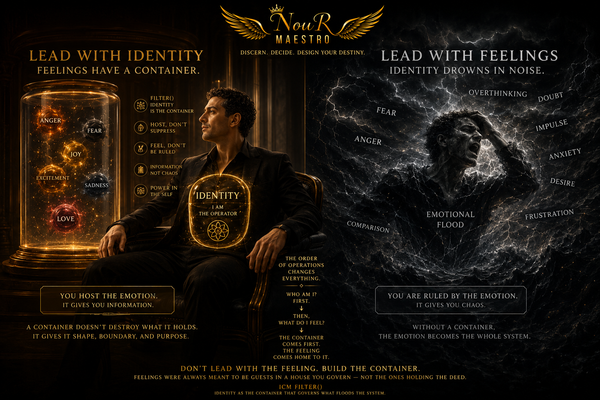
This line lives in Maestro Mornings, Part I of The Sovereign Trilogy (The Maestro Code). It activates the ICM SAVE() function — protecting a committed, soul-sealed state from the ego's unauthorized rollback, reopening only for genuinely new data.
Read next: "I'm Possible" Is Not a Result. It's a Position You Hold. · "No" Is Not a Negotiation. It's a Decision.
Note: ICM is a descriptive lens for understanding inner patterns — not a clinical protocol or a substitute for professional support.