When You Lead with Identity, Feelings Have a Container

When You Lead with Identity, Feelings Have a Container
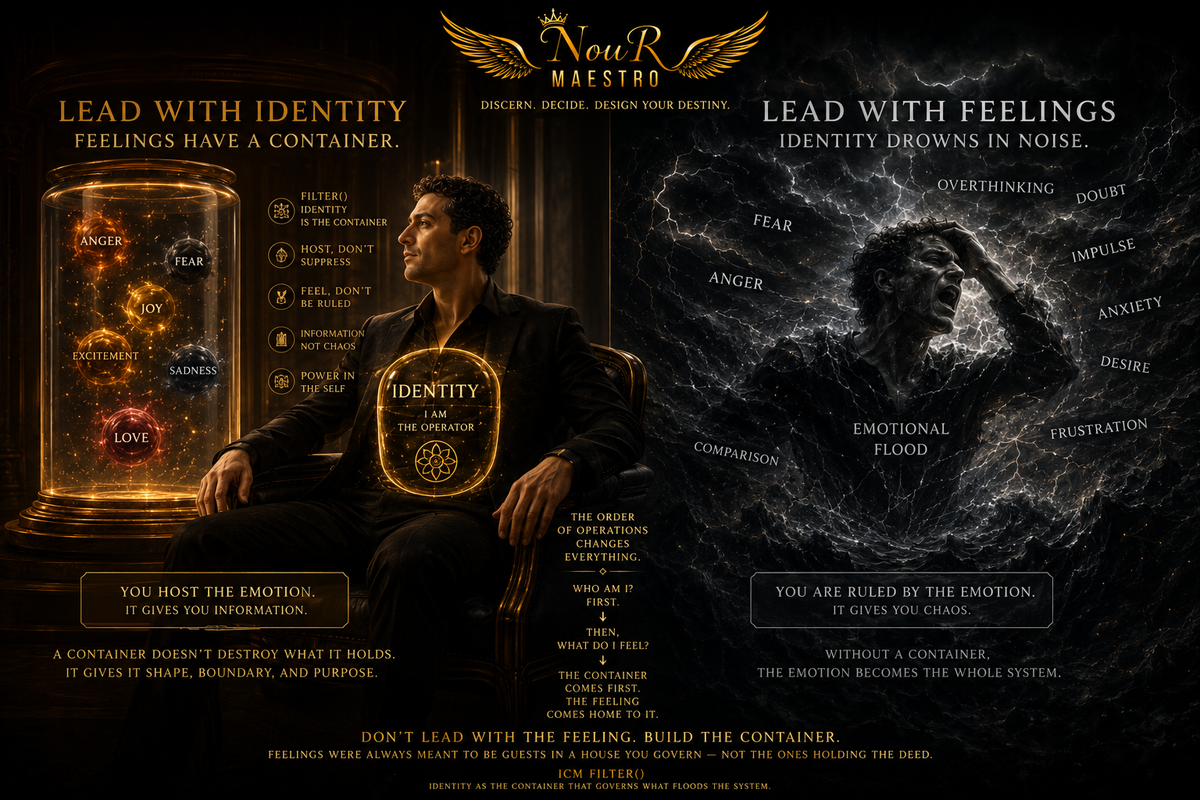
"When you lead with identity, feelings have a container. When you lead with feelings, identity drowns in noise."
There's a widely believed instruction that runs like this: your feelings are your truest compass, so let them lead. Feel first, then decide. Check in with the emotion and let it steer. It sounds like authenticity. In practice, it hands the controls to the most volatile process in your system and calls the surrender honesty. Lead with feeling, and you don't get clarity — you get flooded.
The distortion. The program equates leading with emotion with being true to yourself. Under that code, putting identity first feels like suppression — like denying what you feel. So you let the feeling arrive and immediately take command, and every strong emotion becomes a governor with full authority over your decisions. But emotion was never built to govern. It's built to signal. Appoint the signal as the ruler and you don't become more authentic — you become noise with a person attached, your identity dissolving into whatever you happen to feel most intensely in the moment.
The mechanism. This is FILTER() — identity operating as the container. Read the line precisely: feelings don't get deleted when you lead with identity. They get contained. A container doesn't destroy what it holds; it gives it a shape, a boundary, a form in which it becomes usable. Lead with identity and the feeling enters a governed vessel — it's hosted, bounded, read for its information. Lead with feeling and there's no container at all, so the emotion floods the whole system and identity drowns in it.
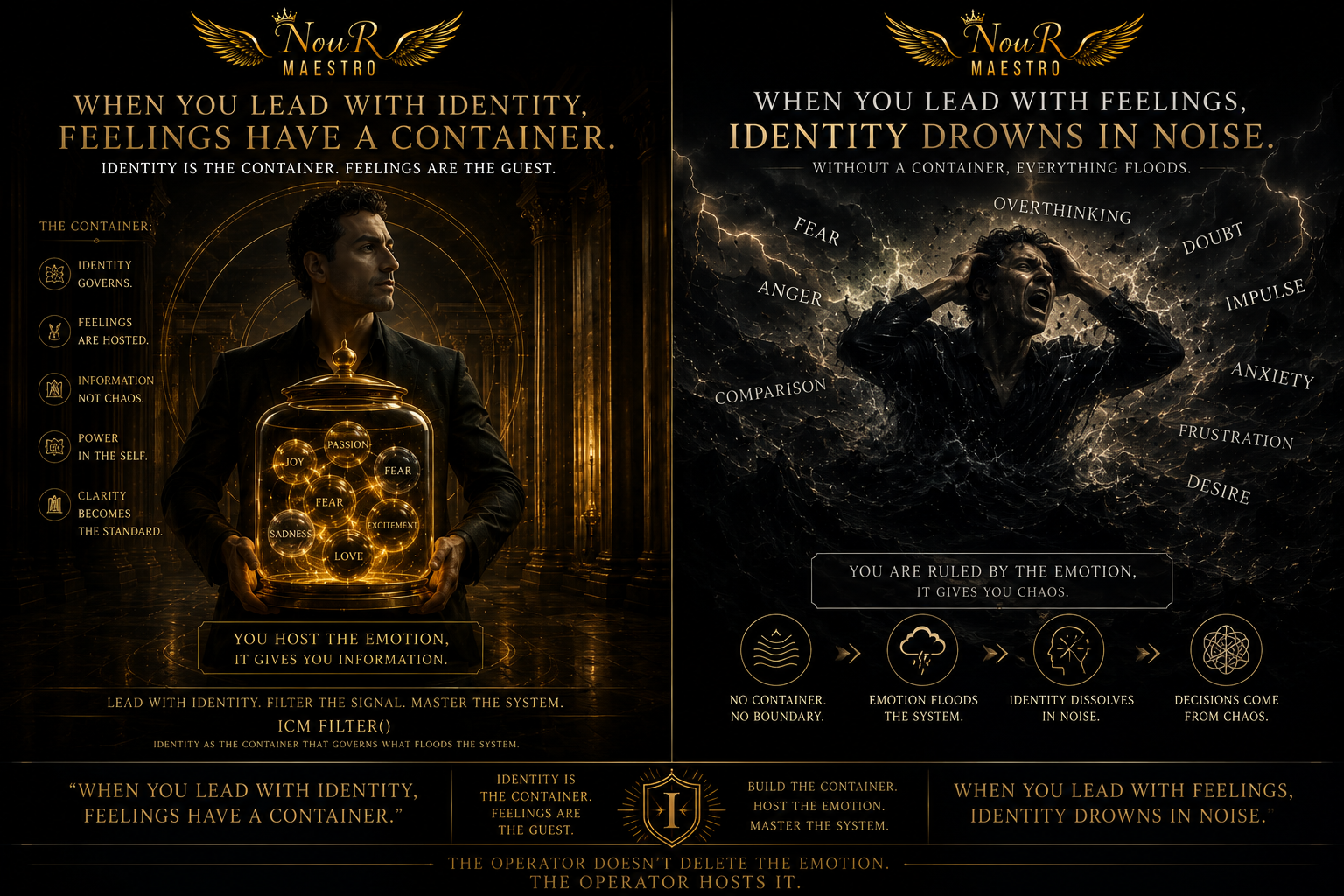
The Science of Power names the same mechanism exactly: power in the self does not suppress emotion — it hosts it. An emotion that is hosted delivers intelligence. An emotion that rules creates chaos. Hosting requires a host — a stable identity present before the feeling arrives, ready to receive it as a guest rather than be evicted by it. FILTER() is that host function: it establishes who's governing first, so that everything arriving afterward enters as input to be processed, not as a command to be obeyed.
Notice this isn't emotional coldness. The container doesn't reject the feeling — it makes the feeling safe to have. You can feel the full force of something when there's an identity sturdy enough to hold it. It's precisely when there's no container that emotion becomes dangerous, because there's nothing to keep it from becoming the whole system. The people most flooded by their feelings aren't the ones who feel most — they're the ones who lead with feeling and have no vessel to hold it.
The install. When this line runs, you change the order of operations. Before what do I feel? comes who am I? — not to silence the feeling, but to establish the container that lets you actually use it. When emotion floods, the sovereign move isn't to obey it or to suppress it. It's to lead with identity so the feeling has somewhere to land. You host the emotion instead of being ruled by it, and hosted emotion hands you information instead of chaos.
Feelings were always meant to be guests in a house you govern — not the ones holding the deed.
"When you lead with identity, feelings have a container. When you lead with feelings, identity drowns in noise."
Read it again. Don't lead with the feeling. Build the container, and let the feeling come home to it.
This line lives in Maestro Mornings, Part I of The Sovereign Trilogy (The Maestro Code), and runs on the same principle as The Science of Power (Ch. 12, Power in the Self): the self hosts emotion rather than suppressing or obeying it. It activates the ICM FILTER() function — identity as the container that governs what floods the system.
Read next: When You Start with Emotion, You Serve the Storm · If You Don't Name Your Atmosphere, the Algorithm Will
Note: ICM is a descriptive lens for understanding inner patterns — not a clinical protocol or a substitute for professional support.