When You Start with Emotion, You Serve the Storm


"When you start with emotion, you serve the storm. When you start with ritual, you govern it."
-NOUR MAESTRO
Watch how a day actually begins. The eyes open and before a single decision is made, the system is already running something — a check of the phone, a flood of notifications, a residue of last night's worry. By the time you're "awake," you've already been programmed. You didn't start the day. The day started you.
That's what it means to serve the storm. The weather inside you sets the agenda, and you spend the next sixteen hours reacting to a mood you never chose.
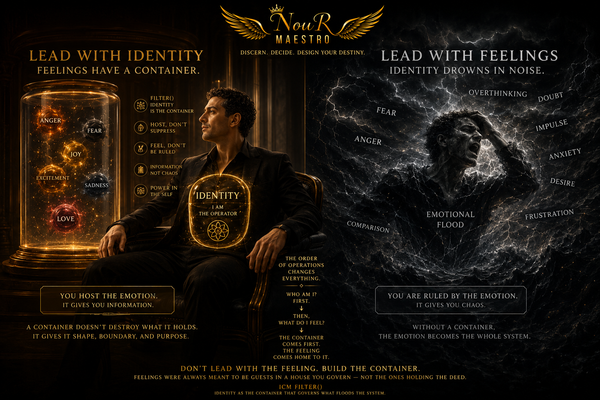
The distortion. The cultural script says feelings are the truest signal — check in with how you feel, lead with your emotions, honor what's coming up. As a first move, this is catastrophic. Emotion is real data, but it is not a governor. Hand emotion the opening slot and you've appointed the most volatile process in your system as the operating authority for the entire day. The storm doesn't want to harm you. It just has no interest in your direction.
The mechanism. Ritual is not the suppression of emotion. It's the sequencing of it. When you open the day with a fixed, authored sequence — a chosen first action that runs regardless of how you feel — you establish identity before feeling gets write-access. The emotion still arrives. But now it arrives into a system that's already governed, and it lands as input instead of seizing control as command.
Two functions. RUN() — the ritual is code you execute in real life, on schedule, whether or not the mood cooperates; that's what makes it ritual and not whim. And LOOP() — because the alternative is already a loop. Wake → react → mood-rules-the-day is an inner habit loop running on autopilot. Ritual is the deliberate loop installed over the automatic one. You don't delete the morning loop. You author it.
There's a reason the line says govern, not defeat. You're not at war with the storm. You're its sovereign — and a sovereign doesn't stop the weather. They simply refuse to let it write policy.
The install. When this line runs, the question on waking changes from how do I feel? to what runs first? You install a non-negotiable opening sequence — one action, authored by you, executed before the storm gets a vote. It doesn't have to be elaborate. It has to be first. Whoever moves first governs the field, and on the field of your own day, the first move is always available to you.
This is the difference between a life that is weathered and a life that is led.
"When you start with emotion, you serve the storm. When you start with ritual, you govern it."
Read it again. It's not asking you to feel less. It's telling you who goes first.
This line opens Maestro Mornings, Part I of The Sovereign Trilogy (The Maestro Code) — the ICM architecture of governed time. The principle beneath it: when you negotiate your morning, you subcontract your sovereignty.
Read next: You Are Not a Reaction. You Are a Code · Sovereignty Is Your Crown, Dependency Is Your Abdication
Note: ICM is a descriptive lens for understanding inner patterns — not a clinical protocol or a substitute for professional support.