
"Sovereignty is your crown. Dependency is your abdication."

NOUR MAESTRO
Inner Coding Mastery · Problem / Solution
Why You Can't Stop Depending On One Person
— And What It's Really Costing You
You know the feeling.
When they don't reply, your entire system goes offline. When they seem distant, the anxiety arrives before the thought. When the relationship shifts — even slightly — something in you destabilizes in a way that feels completely disproportionate to what actually happened.
It could be a lover. A parent. A best friend. A mentor.
The person changes. The dynamic changes. The intensity varies. But the structure is always the same: one person has become the load-bearing wall of your inner architecture. And somewhere beneath the love, beneath the attachment, beneath the genuine connection — you know it. You can feel the weight you have placed on them. And you can feel what happens to you when they move.
This article is not about whether to love deeply. Deep love is not the problem.
The problem is structural. And it has a name in Inner Coding Mastery.
It is called an external SAVE().
What is actually happening — precisely.
In ICM, SAVE() is the function that stores what you need to run. Your sense of value. Your emotional stability. Your identity confirmation. Your sense of being enough.
Every human being needs these things stored somewhere. The question is where.
When the SAVE() function runs correctly, these things are stored internally — in your own architecture, built through self-knowledge, examined experience, and conscious identity construction. You carry your own stability. You bring your presence to relationships rather than seeking your presence through them.
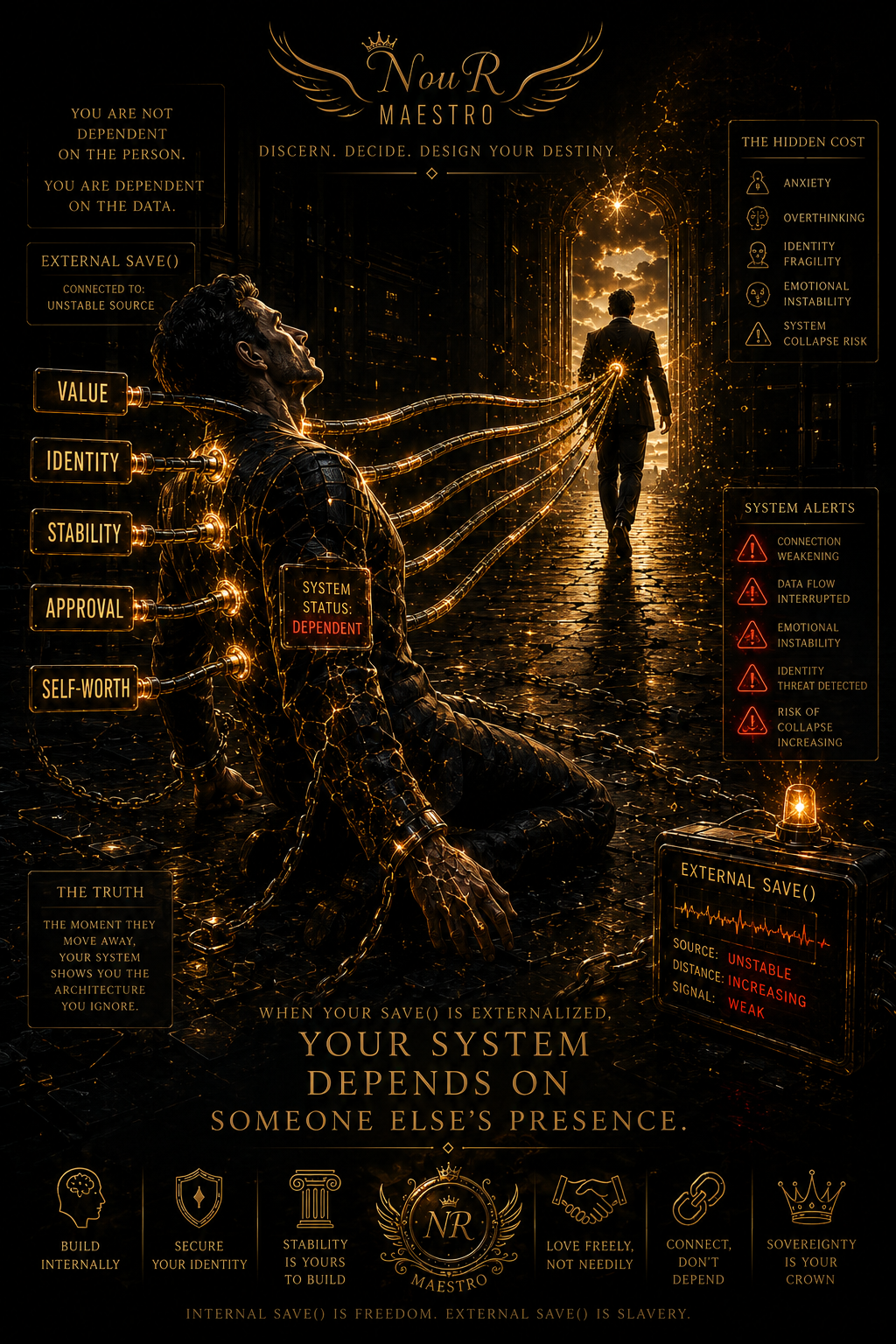
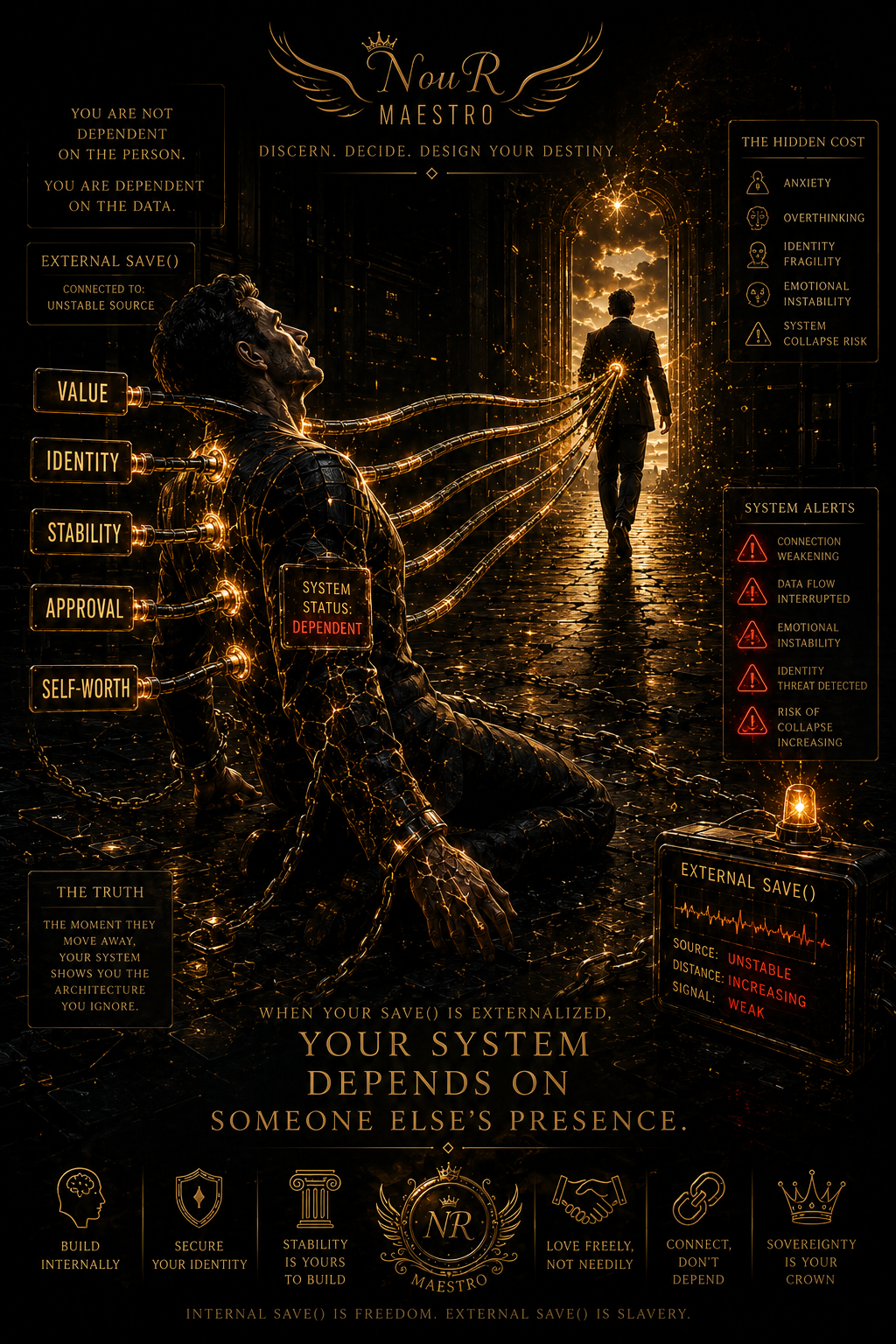
When the SAVE() function has been externalized — placed in another person — something different happens. Your emotional operating system runs a check every time you need stability:
Is the person available? → System stable.
Is the person distant? → System unstable.
Does the person approve? → Identity confirmed.
Does the person withdraw? → Identity threatened.
You are not dependent on the person. You are dependent on the data they provide to a function that should be running internally. They have become your external hard drive — and without access to them, the system cannot retrieve what it needs to function.
This is not weakness. It is a structural gap.
How the external SAVE() gets installed.
Nobody chooses this consciously. The installation happens early — and it happens logically, given the environment in which it occurs.
When a child's sense of value is consistently confirmed by a parent's approval and threatened by a parent's withdrawal — the system learns: emotional stability comes from outside. Specifically, it comes from the responses of the most significant person in the environment.
This is not a malfunction. In that environment, it was accurate. The child did not have the capacity to generate internal stability independently. The parent was the source. The dependency was appropriate to the developmental moment.
The problem is that this program does not automatically update when the developmental moment passes. It continues running — the same logic, the same external orientation, the same SAVE() function pointed outward — into adult relationships that were never designed to carry that weight.
The lover who must constantly reassure you is carrying the weight of a parent who never did.
The friend whose approval you cannot stop seeking is holding the mirror that was never stable in childhood.
The mentor whose validation you need before you can trust your own decisions is running an old program from a time when you genuinely could not trust your own judgment.
The relationship in the present is real. The need you bring to it is also real. But the volume and structure of that need was installed in a different context entirely — and it is being applied to someone who did not sign up to be a system dependency.
What it costs — both of you.
The cost to you is the most visible. But the cost to the relationship is equally real.
What it costs you:
Your freedom. When one person holds your emotional stability, your entire experiential world narrows around their state. Their mood becomes your weather. Their availability becomes your schedule. Their opinion becomes your compass. You are not free — you are tethered. And the tether tightens every time the attachment deepens.
Your identity. The self that is confirmed externally is not built — it is rented. Every time the external source withdraws, the self becomes uncertain. This produces the specific anxiety of dependency: not fear of losing the person, but fear of losing yourself when they are gone. Because the version of yourself that exists only in relation to them is not a full self. It is a reflection. And reflections disappear when the mirror moves.
Your power. Every decision filtered through "what will they think" is a decision that was never fully yours. Every action taken to maintain the relationship rather than to express yourself is an action that serves the dependency rather than your life. The accumulation of these decisions over years is a life that was shaped by the proximity of one person rather than by your own architecture.
What it costs them:
The weight of being someone's system dependency is not love. It is a burden that eventually collapses even the strongest connection. People who are used as external SAVEs — however unconsciously — eventually feel it. The pressure to always be available. The responsibility for another person's emotional stability. The impossibility of being human — of having bad days, of needing space, of growing in directions that don't serve the other person's dependency — without triggering a crisis.
Dependency disguised as love is one of the most common ways deep connections are destroyed.
The ICM diagnosis
— which function has failed?
In Inner Coding Mastery, over-reliance on one person is not primarily a relationship problem. It is an inner architecture problem.
The CONNECT() function — which governs how you link to others — is running without the foundation that makes healthy connection possible: an internal SAVE().
You cannot CONNECT() cleanly when you are using the connection to compensate for what is missing inside. What looks like intimacy is often retrieval — accessing from another person what you have not yet built in yourself.
The sequence that needs to run:
ANALYZE()       → examine what you are
                  actually seeking from this person

FILTER()        → separate genuine love and
                  connection from dependency
                  and retrieval

RE-EVALUATE()   → question the belief that
                  your stability must come
                  from outside yourself

MODIFY()        → begin building the internal
                  SAVE() — the stored sense
                  of value that does not
                  require external confirmation

CONNECT()       → return to the relationship
                  from a different position —
                  choosing rather than needing
This sequence does not end the love. It changes its structure. From dependency to choice. From retrieval to contribution. From tether to genuine connection between two people who are each capable of standing alone.
What building the internal SAVE() actually looks like.
This is not a philosophical project. It is a practical one.
It begins with writing — because the external SAVE() was built through external confirmation, and the internal one is built through self-examination on paper.
Every day, the practice is simple and non-negotiable:
Write what you value about yourself — not what others have confirmed, but what you have observed in your own behavior, your own decisions, your own responses to difficulty.
Write what you know to be true about yourself — independent of whether anyone else agrees.
Write what you would think of yourself if the person you are most dependent on disappeared entirely from your life tomorrow.
That last question is the most diagnostic. The gap between who you are with them and who you are without them is the exact size of the external SAVE() you have placed in them. That gap is what needs to be built internally.
This is not fast work. The external SAVE() was installed over years. The internal one is built through consistent practice — through the daily execution of self-knowledge until the retrieval function that currently points outward begins, gradually and then permanently, to point inward.
The goal is not independence. It is sovereignty.
"Sovereignty is your crown.
Dependency is your abdication."
NOUR MAESTRO
One more thing that needs to be said precisely, because ICM is not a philosophy of isolation or emotional self-sufficiency as an end in itself.
A crown is not taken from you. It is surrendered — one external SAVE() at a time, one borrowed identity confirmation at a time, one relationship used as a system dependency at a time. Abdication is rarely dramatic. It happens quietly, in the daily accumulation of needing one person's presence to feel whole.
The goal is not to need no one.
The goal is to need no one for what only you can provide yourself.
There is a difference between choosing someone and needing them for your functioning. Between loving deeply and making one person the load-bearing wall of your inner architecture. Between genuine intimacy and structural dependency.
Sovereignty in relationships looks like this: you bring your wholeness to another person's wholeness. You choose them — consistently, deliberately, from a place of internal stability — rather than requiring them as the condition for your stability.
That kind of connection is not less loving. It is more so. Because it is free. Because it is chosen. Because it is not burdened by the weight of what it is compensating for.
When your internal SAVE() is built — when you carry your own sense of value, your own identity, your own emotional foundation — you stop depending on one person.
And you finally start genuinely connecting with them.
This article is part of the ICM series on nourmaestro.com.
Read the foundation: What is Inner Coding Mastery
https://www.nourmaestro.com/what-is-inner-coding-mastery/
On the FILTER function: https://www.nourmaestro.com/inner-coding-mastery/
The Golden Rule: https://www.nourmaestro.com/you-are-the-master-of-your-page/
— NOUR MAESTRO · Inner Coding Mastery · nourmaestro.com