Inner Coding Mastery


The"FILTER Function"
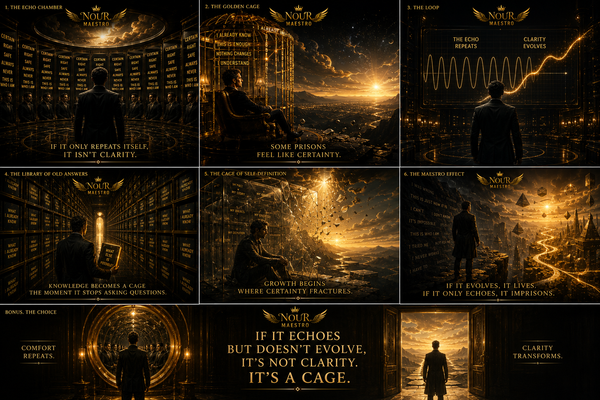
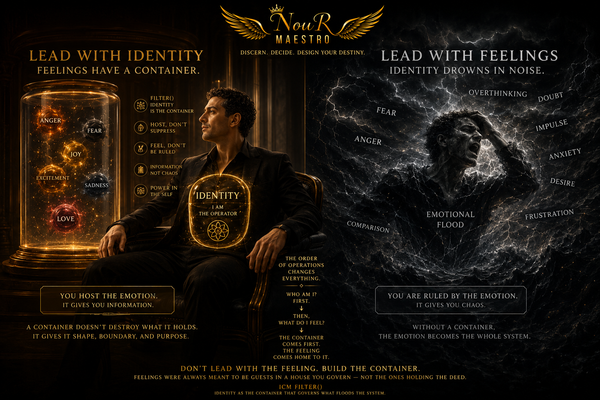
The voice in your head may not be yours.
You wake up with a thought. It feels familiar. It feels true. It has been there so long it feels like you.
But here is the question ICM forces you to ask before anything else:
"Is this thought actually mine — or did someone else write it into my system before I was sophisticated enough to refuse the installation?"
That question is FILTER().

What is the FILTER Function?
FILTER() is the second function in Inner Coding Mastery. It is not about positive thinking. It is not about gratitude or reframing. It is a precise cognitive operation — the first act of genuine sovereignty over your own mind.
As NOUR MAESTRO writes in BLANK PAGE & A PEN:
"When your thoughts are tangled, a stranger's voice can feel like your own. Is this your truth, or your parents'? Is this your dream, or society's image? Is this your desire, or a borrowed standard? You don't know — until you write it down."
Writing is the FILTER mechanism. Not therapy. Not meditation. Writing — because a thought that stays in your head cannot be examined from the outside. You are inside it. You cannot see its edges, its origin, or its source.
The moment it lands on paper, you are no longer inside it. You are its examiner.
Why most people never run FILTER().
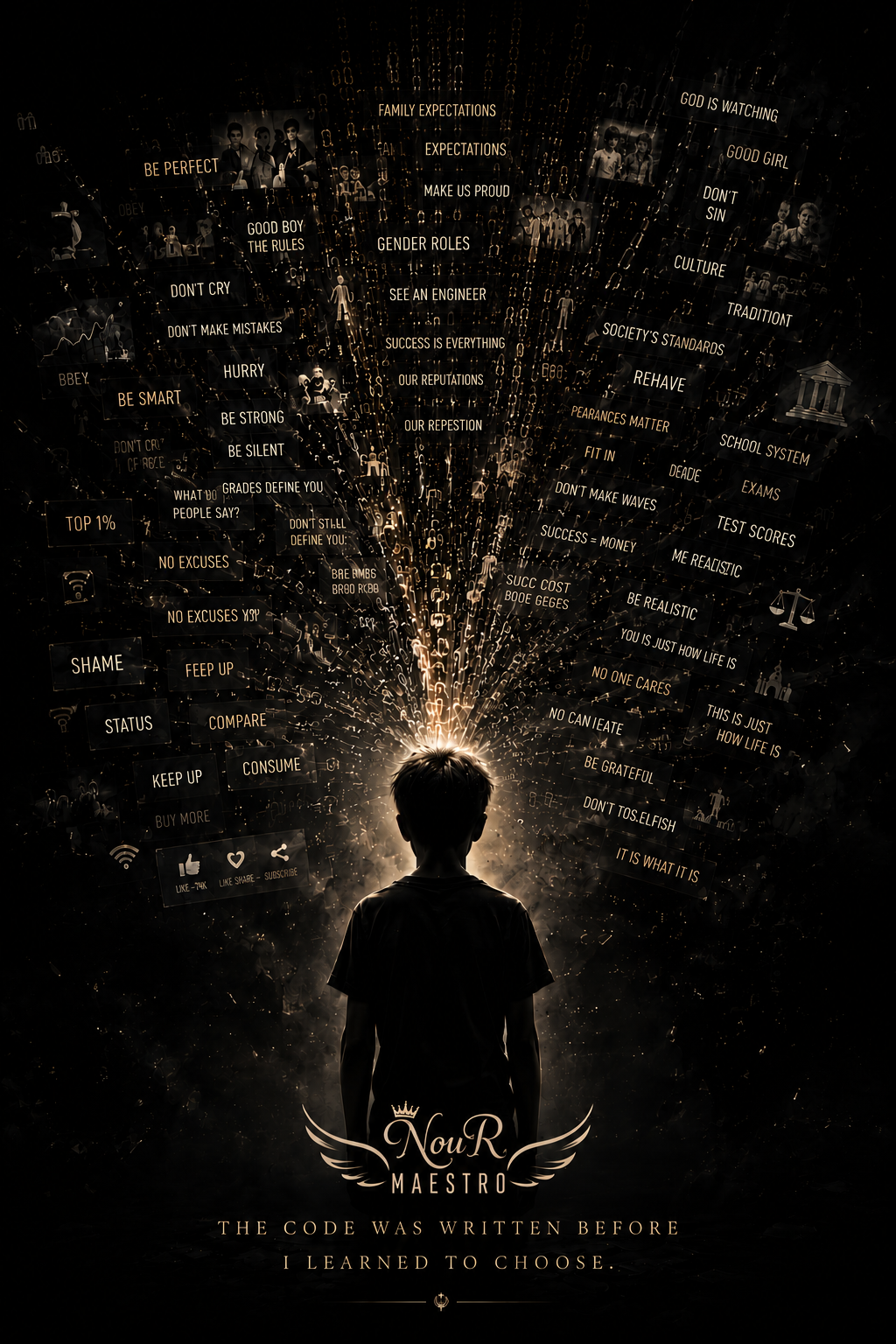
The human system is installed before it is functional enough to protect itself.
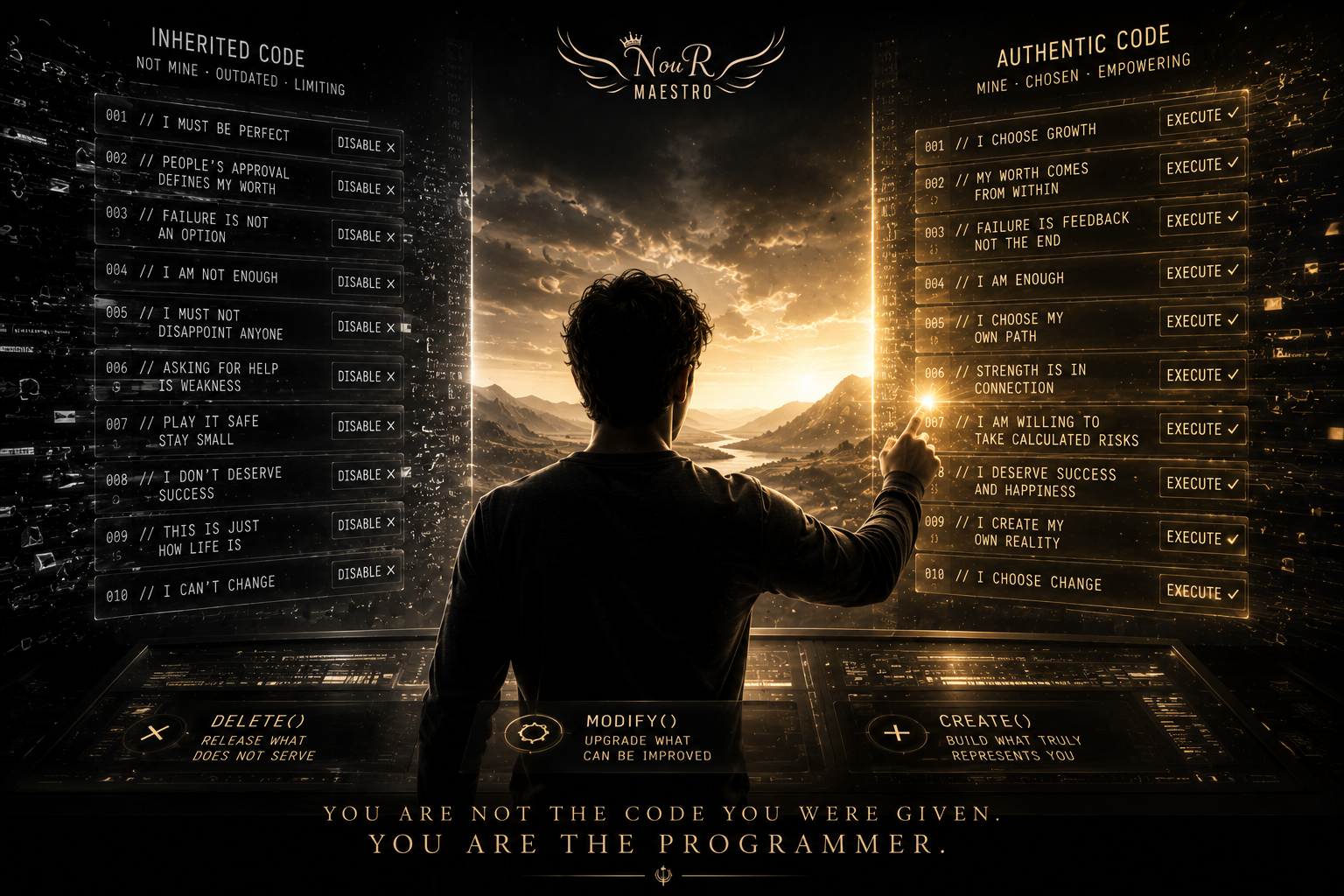
Before the age of conscious discernment, the environment writes directly into your operating system. Parents. Culture. Religion. School. Trauma. Repetition. These are not malicious actors — they are simply the first programmers your system encountered. And they wrote code that felt, at the time, like survival.
The problem is not the installation. The problem is that most people never audit it.
They carry beliefs that were never theirs. They make decisions from values they never chose. They feel guilt, shame, obligation, and limitation — not because these responses are accurate, but because they are running programs that were written in a different environment, for a different version of themselves, decades ago.
FILTER() is the audit.

What FILTER() actually does — precisely.
FILTER() does not delete. That is DELETE()'s function.
FILTER() does not rewrite. That is MODIFY()'s function.
FILTER() does one thing: it separates signal from noise. It answers one question for every thought it examines:
Does this belong to me — or was it installed?
This is not a philosophical exercise. It is a practical one. You write the thought. You study its origin. You identify whether it serves your current architecture or whether it is legacy code running on autopilot.
From BLANK PAGE & A PEN:
"Writing is the first cognitive filter. It is your internal blood test. It reveals the viruses you have caught through repetition, exposure, or pain."
A virus does not announce itself. It runs quietly, shaping behavior, limiting decisions, generating responses that feel like your own but originate elsewhere. FILTER() makes the virus visible.
How to execute FILTER() — the practical protocol.
Step 1 — Write without censorship.
List 10 recurring thoughts that carry weight. Beliefs about yourself, about what you deserve, about what is possible, about who you are.
Examples from the book:
"I must always be successful."
"If I disappoint people, I am worthless."
"I am not enough."
"It is weak to ask for help."
Step 2 — Interrogate each one.
For every thought on the list, ask three questions:
Where did this thought come from?
Is this actually my voice?
Does it serve me — or sabotage me?
Step 3 — Mark the foreign code.
If the thought does not belong to you — if its origin is external, its function is limitation, and its presence is inherited rather than chosen — mark it.
Not with guilt. Not with judgment toward those who installed it.
With clarity. With the cold precision of a programmer who found the bug.
Step 4 — Hand it to the next function.
Filtered thoughts that belong to you — keep running. Filtered thoughts that are foreign and destructive — pass to DELETE().
FILTER() does not make the final decision. It makes the decision visible.
The difference between FILTER() and overthinking.
This is important to clarify because FILTER() can be misread as an invitation to endless self-analysis.
Overthinking is FILTER() without execution. It is the loop of examining without deciding — of identifying a thought as problematic and then continuing to run it anyway because the examination never moved to action.
FILTER() in ICM always moves forward. It identifies — and then passes the result to the next function. The examination has a purpose. The purpose has a next step. The next step has an output.
Overthinking is a loop.
FILTER() is a sequence.

What changes when you run FILTER() consistently.
The first time you run FILTER(), you will find one or two beliefs that clearly do not belong to you. This is already significant.
After 30 days of consistent practice, something more important happens: you develop the capacity to run FILTER() in real time. You encounter a situation — a conflict, a decision, a reaction — and before you respond from the installed program, you pause. You ask the question. You identify the source.
That pause is the gap between the stimulus and your response. In that gap, you are no longer a subject running inherited code. You are the programmer deciding which code to execute.
That is not a small change.
"That is the beginning of sovereignty."
This article is part of the ICM series on nourmaestro.com.
Start with: What is Inner Coding Mastery — The Complete Definition
https://www.nourmaestro.com/what-is-inner-coding-mastery/
— NOUR MAESTRO · Inner Coding Mastery · nourmaestro.com