If You Don't Name Your Atmosphere, the Algorithm Will


If You Don't Name Your Atmosphere, the Algorithm Will
NOUR MAESTRO
You have an inner atmosphere — the ambient emotional and mental weather you move through a day inside. And here is the part most people never confront: that atmosphere is authored. The only question is by whom. Because if you don't set it deliberately, something else will set it for you — and that something is increasingly a system engineered, with enormous precision, to capture and hold your attention by keeping you in a particular state. You wake up neutral. Within minutes, you've been atmosphered — by a feed, a notification, a stream of inputs you didn't choose, calibrated to keep you scrolling.
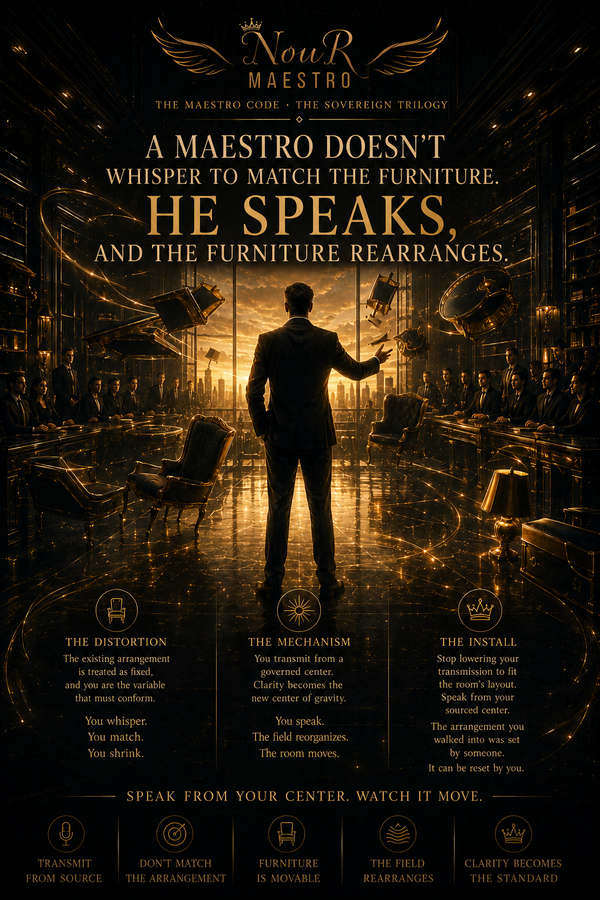
The distortion. The program treats atmosphere as something that simply happens to you — a mood you find yourself in, weather that rolls through. Under that belief, you never name it, because you don't think it's yours to name. So you leave the channel open by default. And a default-open channel doesn't stay empty; it fills with whatever has the strongest incentive to fill it. You experience the result as how you feel today, never noticing that "how you feel today" was substantially authored by systems optimizing for engagement, not for your sovereignty.
The mechanism. This is CONNECT() — the function that governs what you're plugged into. Your atmosphere is downstream of your connections: the inputs, feeds, voices, and channels you're linked to. CONNECT() is the deliberate act of choosing those channels rather than accepting the ones assigned to you. The line frames it as a contest of authorship: name your atmosphere (author your connections consciously) or the algorithm will (an external system authors them for you, in its interest, not yours).
Name is the operative verb, and it's not casual. Naming is the act of claiming authorship — the same move as defining a problem to collapse its invisible walls. An unnamed atmosphere runs on autopilot, set by whatever you happened to connect to. A named atmosphere is a decision: I am choosing what I let into my field, what I connect to first, what gets a channel to my inner state and what doesn't. The Impossible book asks it directly — who's around you; do their words build or break your belief? CONNECT() extends that question to every input, human and digital alike.
This is the same access-control instinct as you are not a button, turned inward. There it governed who could reach you. Here it governs what reaches your atmosphere — what you allow to set the weather you think in. An open port to the algorithm is the most consequential connection most people never consciously made.
The install. When this line runs, you stop treating your inner weather as something that merely descends on you. You name it — deliberately, daily — and you author your connections to match. You decide what gets the first channel in the morning, before the algorithm claims it. You audit what you're plugged into and ask whether each connection builds the atmosphere you chose or hijacks it for someone else's metric. The feed stops being weather and becomes a connection you either authorize or sever.
You will have an atmosphere regardless. The only choice is whether you name it — or let something built to profit from your attention name it for you.
"If you don't name your atmosphere, the algorithm will."
NOUR MAESTRO
Read it again. Author your connections, or be authored by them. There's no neutral setting.
This line lives in Maestro Mornings, Part I of The Sovereign Trilogy (The Maestro Code). It activates the ICM CONNECT() function — consciously choosing the channels and inputs that set your inner atmosphere, rather than defaulting to the ones assigned by external systems.
Read next: You Are Not a Button · Any Space That Needed You Smaller Was Never Big Enough
Note: ICM is a descriptive lens for understanding inner patterns — not a clinical protocol or a substitute for professional support.