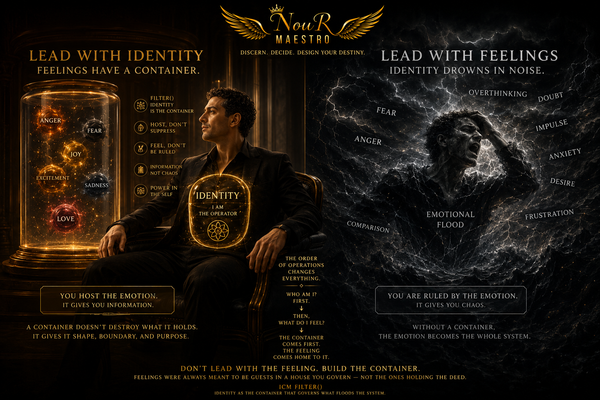
Who You Are Is the Permission You Give Yourself...

"Who you are is the permission you give yourself to become."
NOUR MAESTRO
Most people are waiting for a permission slip. From a parent who will never quite approve. From an institution that keeps moving the bar. From a moment when they'll finally feel ready, qualified, allowed. They treat becoming as something that gets authorized from outside — and so they wait at a door, holding a request, for a signature that was never going to come.
The line ends the wait. The permission isn't issued by anyone else. It's who you are.
The distortion. The program runs identity as inherited and externally validated: I am what I was told I am, and I may only become more once someone with authority confirms it. Under this code, you live inside labels you didn't choose — the early verdicts, the family role, the limit someone handed you before you could argue. And every attempt to become something more feels like trespassing, because you're waiting for an authorization that, by design, keeps not arriving. The gatekeeper you're waiting on doesn't exist. You invented them, then handed them your future.
The mechanism. This is TRANSCEND() — the function that breaks free of inherited identity. Transcendence here isn't escape into the mystical; it's the structural act of issuing your own permission. The line collapses the gap between who you are and the authority to become — they're the same thing. You don't earn the right to become by accumulating external approval. You hold it by virtue of being the one who decides.
Notice the loop the distortion creates: you can't become until you're permitted, and you can't be permitted until someone else becomes the authority over you — which means you never become, because you've outsourced the only signature that mattered. TRANSCEND() severs that loop. It relocates the pen. The permission isn't out there waiting to be granted; it's in here, and it was always yours to sign.
The book frames this as a daily act of courage, and that word matters. Self-issued permission isn't a one-time declaration you make and then coast on. Inherited identity is sticky — the old labels keep trying to reassert authority. So TRANSCEND() runs daily: every time you act as the author of who you're becoming instead of the petitioner waiting to be approved, you weaken the inherited script and strengthen the chosen one.
The install. When this line runs, you stop waiting at the door. You recognize that the signature you've been seeking is one only you can provide — and that you've had the pen the entire time. Who am I to become this? stops being a disqualifying question and becomes its own answer: I am the one who decides. That is who I am.
This connects directly to the foundational install — you are the one who wrote the code. The author of the code is also the issuer of the permission. They were never two different powers. They were always you.
"Who you are is the permission you give yourself to become."
NOUR MAESTRO
Read it again. Stop waiting for the signature. You're holding the pen.
This line lives in The Impossible Is Equal to I'm Possible, in the chapter on transcending inherited identity. It activates the ICM TRANSCEND() function — relocating the authority to become from external gatekeepers back to the self.
Read next: You Are Not a Reaction. You Are a Code. · You Didn't Survive Those Spaces Because They Saw You
Note: ICM is a descriptive lens for understanding inner patterns — not a clinical protocol or a substitute for professional support.