FILTER() — Learning To See What Is Yours And What Was Installed


NOUR MAESTRO · Inner Coding Mastery · The Bullying Code — Part 6
FILTER()
— Learning To See What Is Yours
And What Was Installed
Parts 1 through 5 of The Bullying Code were diagnostic.
They described the mechanism — how the malware installs in the child, spreads through the teenager, runs silently in the adult, and originates in a corrupted system using aggression to hide its own vulnerability.
Diagnosis is the necessary first step. You cannot examine what you cannot see. You cannot question what you have not yet identified as questionable.
Part 6 begins the second half of the series — the ICM functions as descriptive lenses for understanding what the repair involves. Not a protocol to follow mechanically. A framework for seeing more clearly what is happening in the inner system that carries the damage.
The first lens is FILTER().
What FILTER() describes.
In Inner Coding Mastery, FILTER() is the function that asks one question about any thought, belief, or response that arises in the system:
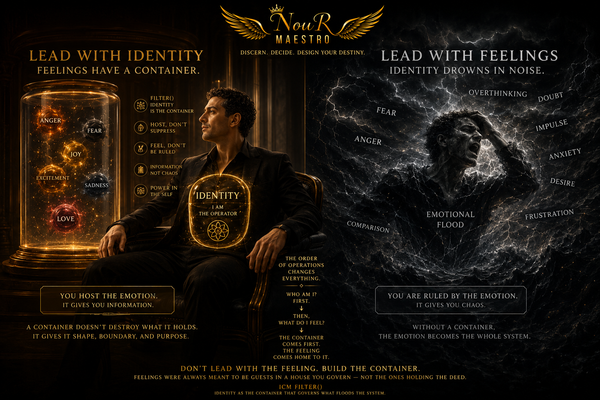
Is this mine — or was it installed?
This sounds simple. It is not.
The difficulty is not in understanding the question. It is in the fact that what was installed early enough, and repeated consistently enough, does not feel installed. It feels original. It feels like the self — like the way things simply are, not like a conclusion that was drawn in a specific context by a version of you that had no other tools available.
The person carrying bullying damage does not typically experience their responses to social situations as legacy code running. They experience them as accurate perception of reality. The anxiety before a group presentation does not feel like an installed evaluation about the danger of visibility — it feels like an appropriate response to a genuinely risky situation. The reluctance to assert a position in a meeting does not feel like the program that learned smallness meant safety — it feels like reasonable caution.
FILTER() does not tell you that these responses are wrong. It asks where they came from.
That is a different question. And it is the question that begins to create distance between the system and the program it is running.
"The problem isn't the code. The problem is running code
that was never yours."
— NOUR MAESTRO
The code running in the adult who was bullied was not written by that adult. It was written in a context of repetitive harm, by a version of the person who had no framework for questioning it, and it has been running — quietly, consistently, shaping responses — ever since.
FILTER() as a descriptive lens helps name what that looks like in practice.
It looks like a response that is disproportionate to the present situation — where the emotional intensity belongs to a past context, not the current one.
It looks like a pattern that appears across different contexts, different people, different environments — because the program running it is internal, not situational.
It looks like a belief about the self that has never been examined — that feels so foundational it seems unchallengeable. "This is just who I am." "I have always been like this." "This is how I respond to these situations."
These are the signals that FILTER() is identifying something worth examining. Not diagnosing. Not condemning. Identifying.
The specific filter bullying damage requires.
Not all installed code is bullying damage. People carry many programs from many sources — family, culture, early experience of many kinds. FILTER() applied to bullying damage specifically is looking for one pattern in particular:
Responses that were calibrated for an environment of threat that no longer exists.
The evaluation that groups are dangerous — calibrated in a school where groups were, genuinely, the mechanism of targeting.
The evaluation that visibility invites attack — calibrated in an environment where being seen led to being humiliated.
The evaluation that being different is dangerous — calibrated in a context where difference was the stated reason for exclusion.
Each of these evaluations was a reasonable response to a real environment. FILTER() does not invalidate the experience that generated them. It simply asks: is the environment the same now?
In most cases, for most adults, the answer is no.
The office is not the school corridor. The colleague is not the bully. The social situation is not the environment where visibility led to humiliation.
But the program running does not update automatically when the environment changes. It continues to treat the present as if it were the past — because nobody has yet asked it to distinguish between the two.
That is what FILTER() begins to do.
What FILTER() is not — stated honestly.
FILTER() is a lens for understanding. It is not a switch that, once activated, removes the installed program.
The adult who recognizes "this response belongs to a past context" does not immediately stop having the response. Recognition is not resolution. The program has been running for years — sometimes decades. It does not stop running because it has been identified.
What changes with recognition is the relationship to the program. The response still arrives — the anxiety, the reluctance, the automatic smallness — but it is no longer experienced as accurate perception. It is experienced as a program running. And a program that is seen as a program, rather than as reality, begins to loosen its grip.
Slowly. Not dramatically. Over time and with consistent return to the examination.
This is honest about what FILTER() can do as a descriptive lens. It offers a beginning — a way of seeing that creates the conditions for something to change. It does not guarantee the change, or produce it quickly, or make the process comfortable.
The parent and FILTER().
For the parent whose child has been bullied — or whose child is at risk — FILTER() operates as a gift they can offer before the child has the capacity to operate it themselves.
The parent who has examined their own code — who has done the work of asking "is this mine or was it installed?" about their own responses, their own evaluations, their own relationship to visibility and safety and belonging — is able to offer the child something specific:
A different signal in the same moment.
When the child comes home having been targeted, the unexamined parent responds from their own installed programs — with panic, with the urge to fix, with the anxiety of their own unresolved experience being activated. That response communicates to the child: this is catastrophic. Your pain is too large for the adults around you.
The examined parent — the parent who has run FILTER() on their own system — responds from a more accurate place. Not minimizing what happened. Not performing calm they do not feel. But holding the child's experience without being overwhelmed by their own history running alongside it.
That steadiness — that examined presence — is itself a form of FILTER() being offered to a system that cannot yet run it independently.
It is one of the most concrete things an ICM-examined parent can give their child.
"Whatever you study, study it with a COLD BLOOD...
and don't worry when you'll learn your lessons,
Emotions won't need invitations."
— NOUR MAESTRO
Study what is running. With cold blood — with the steadiness of someone who is examining a program, not defending an identity.
The emotions will come. When the examination is genuine — when FILTER() identifies something that was running beneath awareness for years — what follows is often grief. The recognition of what the program cost. The clarity of seeing how long it ran and what it shaped.
That grief does not need to be manufactured or rushed. It arrives when the lesson is genuinely learned — as NOUR MAESTRO says, without invitation.
Cold blood first. Then the emotions that belong to what is true.
This article is Part 6 of The Bullying Code series on nourmaestro.com.
The Bullying Code Part 1:
https://www.nourmaestro.com/they-called-you-names-you-believed-them-that-is-the-real-damage/
The Bullying Code Part 2:
https://www.nourmaestro.com/the-child-silent-installation-how-malware-enters-a-system-that-has-no-firewall-yet/
The Bullying Code Part 3:
https://www.nourmaestro.com/the-teenager-the-spreading-infection-when-malware-becomes-part-of-the-operating-system/
The Bullying Code Part 4:
https://www.nourmaestro.com/the-adult-legacy-malware-running-silently-for-decades/
The Bullying Code Part 5:
https://www.nourmaestro.com/the-bully-a-corrupted-system-running-malware-it-received-from-its-own-aggressor-as-a-defensive-mechanism-and-deflection-tool-to-hide-its-own-vulnerabilities/
What is Inner Coding Mastery:
https://www.nourmaestro.com/what-is-inner-coding-mastery/
— NOUR MAESTRO · Inner Coding Mastery · nourmaestro.com