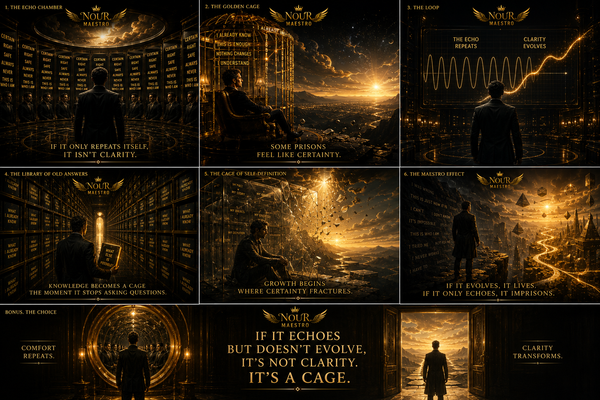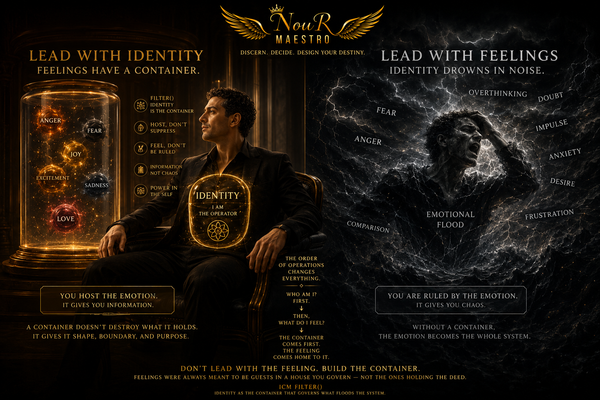
" Misery is the price of ignorance."

NOUR MAESTRO
Nobody chooses to suffer.
That is the first thing to establish — because the moment you read what follows, a part of you will want to resist it. Will want to say: but I didn't choose this. But I had no control. But life happened to me.
And you are right. You did not choose the suffering.
But you may have chosen — or more precisely, inherited without questioning — the ignorance that made the suffering inevitable.
That is the distinction this article is built on. And it is a distinction that changes everything.
Ignorance is not stupidity.
Before we go further, this needs to be said precisely, because the word ignorance carries weight that is often misread.
Ignorance in the ICM framework does not mean lacking intelligence. It does not mean being uneducated. It does not mean being weak or broken or beyond repair.
Ignorance means one specific thing:
Not knowing how your inner system works.
That is all. Nothing more, nothing less. The most intelligent person in the room can be profoundly ignorant of their own inner architecture. The most educated person at the table can be running programs they have never examined, making decisions from beliefs they never chose, producing suffering they cannot explain because they have never looked at the code beneath the behavior.
Ignorance of Inner Coding Mastery is not a character flaw.
It is a gap in operating knowledge.
And like any gap in operating knowledge — it has consequences.
The cost is always paid.
The question is only when???
Here is what most people believe: that ignorance is neutral. That not knowing something carries no price until the knowledge becomes necessary.
This is incorrect.
Your inner system runs whether you understand it or not. Your programs execute whether you have examined them or not. Your loops repeat whether you have identified them or not.
The system does not pause while you decide whether to engage with it. It runs. Constantly. Automatically. Without your permission and without your conscious participation.
And when you do not understand a system that is running your life — the output of that system is not neutral. It is not comfortable silence. It is not peaceful waiting.
The output of an unexamined system is suffering.
Not occasionally. Not dramatically. Quietly. Persistently. In the gap between who you sense you could be and who you experience yourself as being. In the relationships that repeat the same patterns with different people. In the decisions that always seem to lead to the same walls. In the feeling — familiar, chronic, difficult to name — that something is running in the background that you cannot access and cannot stop.
That feeling has a name in ICM.
"It is called the price of ignorance."
NOUR MAESTRO
What the ignorance looks like — specifically.
Ignorance of your inner system does not look like dramatic suffering. That is important to understand because most people are waiting for a crisis before they decide to examine how they operate.
But the price is usually paid in smaller denominations. Daily ones.
It looks like reacting to a situation with a force that the situation does not justify — and not understanding why. The anger that arrives before the thought. The anxiety that precedes any event involving visibility or judgment. The shutdown that happens when intimacy gets too close. These are not personality traits. They are installed programs running without oversight.
It looks like the pattern that follows you across contexts. The same dynamic in every workplace — a different manager, a different city, the same invisible conflict. The same relational structure repeated across every significant relationship — different people, same architecture. Different stage, same script. When the pattern follows you everywhere, the pattern is inside you. And if you do not understand your inner system, you cannot find it. You can only experience its output — which is the suffering of repetition without comprehension.
It looks like the ceiling you cannot explain. The point beyond which your progress consistently stalls — in income, in creative output, in intimacy, in self-expression. Not because the external world is blocking you, but because an internal program is running a limit that was installed before you were sophisticated enough to question it. "People like us don't get that." "Who am I to want more." "Success is dangerous." These are not thoughts. They are executable commands. And they execute — whether you are aware of them or not.
This is what ignorance looks like. Not dramatic. Not visible from the outside. But consequential. Reliably, persistently consequential.
Why people stay in the ignorance.
This is perhaps the most important question — and it deserves a precise answer, not a compassionate one.
People stay in ignorance of their inner system for one primary reason: examining it feels more dangerous than enduring the suffering it produces.
This is not irrational. It is logical — from within the logic of the system that is protecting itself.
The programs installed in your inner architecture were, at the time of installation, functional. They were responses to real environments, real threats, real relational dynamics that required real adaptations. The belief that you must not be too visible was not arbitrary — it was a response to an environment where visibility led to punishment. The belief that you must earn love through performance was not invented — it was learned in a context where love was conditional on output.
These programs feel like truth because they once were functional. They feel like identity because they have been running so long they have become indistinguishable from the self.
To examine them is to risk discovering that the architecture you have built your life on was constructed from borrowed materials. That the self you have been defending was assembled from other people's responses to you, not from your own conscious authorship.
That is terrifying.
And so most people choose — unconsciously — to endure the familiar suffering rather than face the unfamiliar examination.
The familiar misery feels safer than the unfamiliar clarity.
This is the deepest form of ignorance: not the absence of information, but the active avoidance of self-knowledge because self-knowledge requires something that feels like destruction before it becomes construction.
What Inner Coding Mastery costs ?
— and what ignorance costs more??
There is a price to learning your inner system. Let us be honest about it.
It costs time. The consistent practice of writing — of running CREATE(), FILTER(), ANALYZE(), RE-EVALUATE() — requires daily engagement with your inner architecture. This is not passive reading. It is active examination.
It costs comfort. You will find programs that were functioning as identity. Beliefs that, once examined, cannot be unexamined. The process of FILTER() and DELETE() is not gentle — not because it is cruel, but because clarity is not the same as comfort.
It costs certainty. The person who has never examined their inner system has a particular kind of confidence — the confidence of someone who has never questioned the foundation. ICM removes that confidence before it replaces it with something more solid. There is a period in the process where the old certainty has been dissolved and the new architecture is not yet complete.
These are real costs.
Now compare them to the cost of ignorance.
Ignorance costs you the gap between your actual potential and your lived experience — paid every day, compounding every year, until the distance between who you could have been and who you experienced yourself as becomes the defining feature of your inner life.
Ignorance costs you the relationships that could not survive the weight of your unexamined patterns — the intimacies that collapsed not because they were wrong, but because the programs running beneath them were never addressed.
Ignorance costs you the decades. Not in a single dramatic loss but in the slow erosion of possibility — option by option, decision by decision, each one narrowed by a program you did not know was running.
Misery is the price of ignorance.
Not as punishment. Not as cosmic judgment.
As output.
A system that is not understood, not examined, not consciously operated — produces outputs that feel like suffering. This is not metaphysical. It is mechanical. The system runs. If the programs are corrupted, the output is corrupted. If the programs are unexamined, the corrupted output continues indefinitely.
The alternative is not happiness.
It is authorship.
This is important to say because Inner Coding Mastery is not a promise of happiness. It is not a path to permanent comfort or the elimination of difficulty.
What it offers is something more precise and more durable than happiness:
Authorship.
The experience of being the one who writes — rather than the one being written. The experience of encountering a difficult situation and responding from a conscious decision rather than an automatic execution. The experience of identifying a pattern before it completes itself, of catching the inherited program before it runs to its familiar conclusion.
This is what the master of the page experiences that the ignorant system-runner does not:
Not the absence of difficulty. But the presence of agency within difficulty.
Not the end of suffering. But the end of the particular suffering that comes from being operated by a system you do not understand and cannot control.
That specific suffering — the suffering of ignorance — ends the moment you begin to examine the code.
Begin here.
Now.
With this.
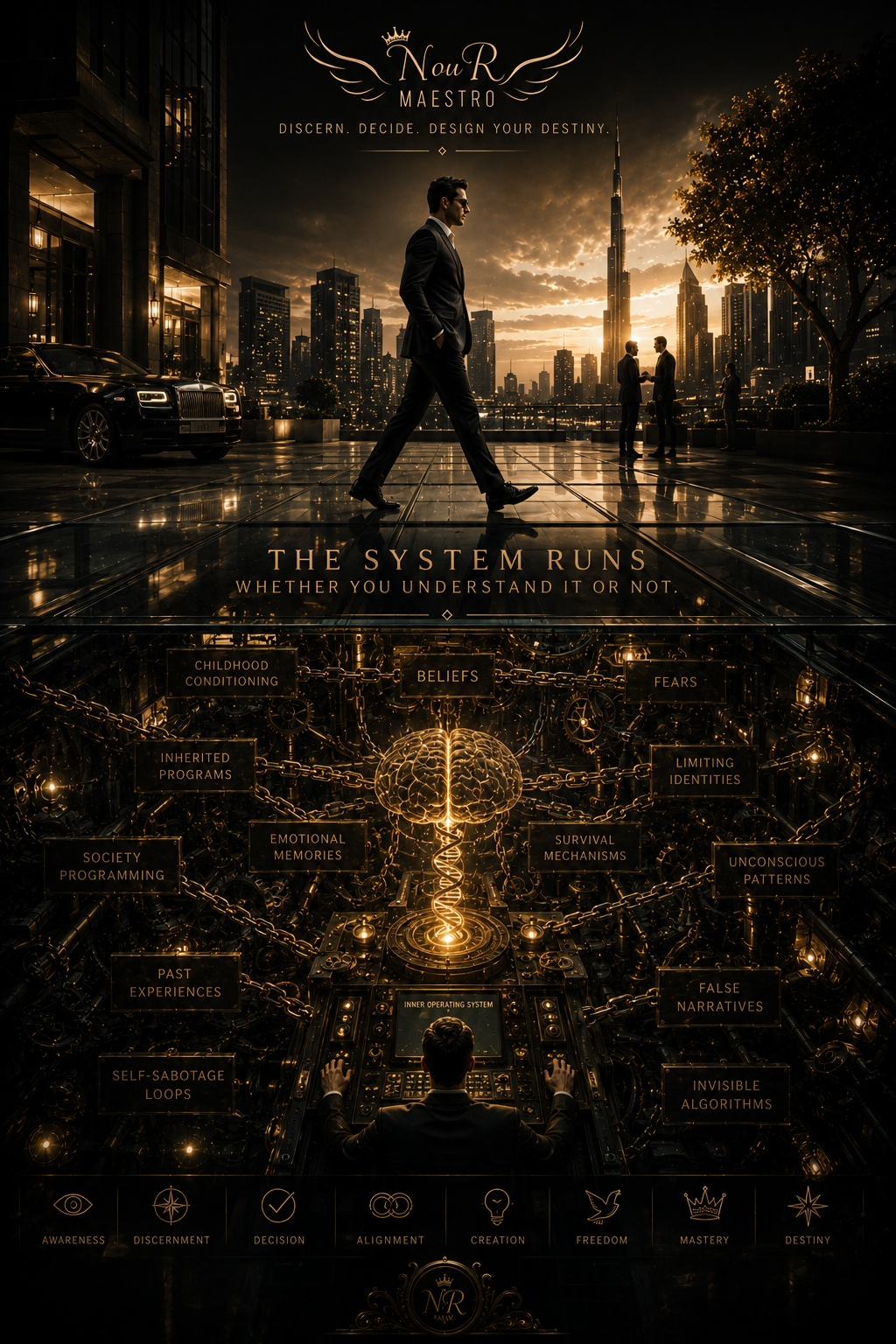
The price of ignorance is not paid in the future. It is being paid right now — in whatever form the unexamined programs are currently producing in your life.
The question is not whether you will eventually face your inner architecture. You will. Either deliberately, through the practice of ICM — through writing, examination, and conscious rewriting. Or eventually, through the accumulated weight of the outputs — the relationships, the ceilings, the patterns, the chronic distance between the life you sense is possible and the life you are currently living.
Either way, you will face it.
The only question is whether you face it on your terms, with a pen in your hand, as the master of your page — or whether you wait for the system to produce a crisis large enough to force the examination.
NOUR MAESTRO's formulation is precise:
"Misery is the price of ignorance."
Not a warning. Not a threat.
A law.
The way gravity is a law. The way a program that is never debugged continues to produce errors indefinitely. The way a page that is never written remains, by default, authored by everyone except the one it belongs to.
The price is real. The payment is ongoing.
The only variable is whether you are paying it unconsciously — or investing it consciously in the examination that ends it.
Pick up the pen.
Write it.
Run the system.
The page is yours.
This article is part of the ICM series on nourmaestro.com.
Start with: What is Inner Coding Mastery — The Complete Definition
https://www.nourmaestro.com/what-is-inner-coding-mastery/
— NOUR MAESTRO · Inner Coding Mastery · nourmaestro.com