Your Ritual Is Not a Rehearsal. It's a Reinstatement.


"Your ritual is not a rehearsal.
It's a reinstatement."
NOUR MAESTRO
People treat their practices like rehearsals — run-throughs for some real performance that's always scheduled for later. I'm working on myself. I'm practicing the new habit. One day this will be who I am. Under that frame, the ritual is preparation, and the actual self is perpetually deferred to a future that never quite arrives. You rehearse calm for a life you haven't started living. You rehearse the new identity for a debut that keeps getting postponed.
The line ends the deferral. The ritual isn't rehearsal for the self. It is the self, re-executed.
The distortion. Rehearsal implies the real thing happens elsewhere, later, in front of an audience that counts. So the practice feels provisional — a draft, not the document. And provisional practice produces a provisional self: one that's always becoming and never being, because every execution is filed as preparation rather than the thing itself. You keep practicing the person you intend to be, and the practicing quietly becomes a way of never having to be them.
The mechanism. This is LEARN() — and in ICM, learning is not the accumulation of information. It's repetition writing code into the operating system. Every time you execute the ritual with presence, you don't rehearse a future self — you reinstate the present one, deeper. The install gets reinforced. The pathway strengthens. This is the principle from the writing work: repetition rewrites reflexes; what you repeat with presence stops being something you try and becomes something you are. Not confidence — code stability.
Reinstatement is the exact word, and it carries weight a coder will feel. You don't reinstall software to practice having it. You reinstall to restore it to active, running status — to make sure the program that should be governing the system actually is. Your ritual reinstates the authored self over the default one that creeps back whenever you stop. Skip the ritual and the old code doesn't politely wait; it reasserts. The reinstatement isn't optional maintenance. It's how the chosen self stays the one that's running.
This reframes resistance, too. When the ritual feels fake early on — when the nervous system says this isn't me — that's not a sign it's failing. That's the old code objecting to being overwritten. The honest response isn't this isn't me. It's not yet — but I'm reinstating it until it is.
The install. When this line runs, you stop treating your practice as preparation for a life you'll live later. Each execution becomes a reinstatement of who you've decided to be — now, today, in this run. The ritual stops being rehearsal for the real thing and becomes the mechanism by which the real thing stays installed. You're not getting ready. You're reinforcing what's already true, until repetition makes it structural.
The self isn't waiting at the end of enough rehearsals. It's reinstated every time you run the code.
"Your ritual is not a rehearsal.
It's a reinstatement."
NOUR MAESTRO
Read it again. You're not practicing to become. You're reinstalling who you already chose to be.
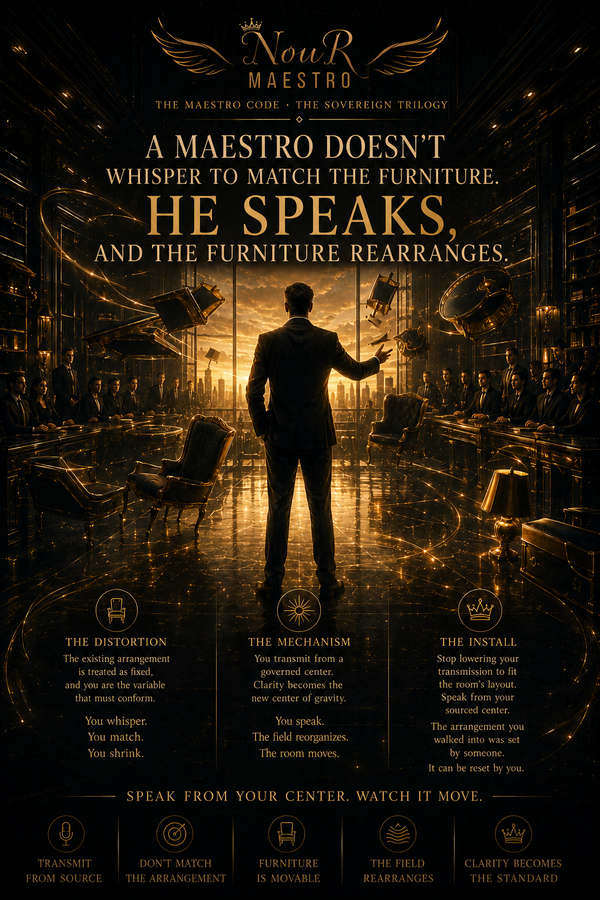
This line opens Maestro Mornings, Part I of The Sovereign Trilogy (The Maestro Code), and runs on the same engine as Blank Page and a Pen — the ICM text on repetition as inner coding. It activates the LEARN() function: repetition that writes the chosen self into the operating system until it holds.
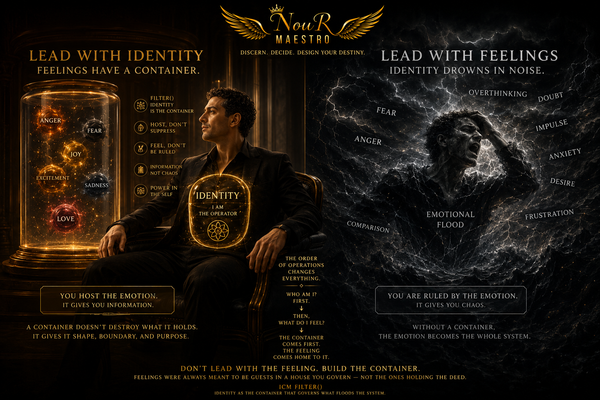
Read next: When You Start with Emotion, You Serve the Storm · You Are Not a Reaction. You Are a Code.
Note: ICM is a descriptive lens for understanding inner patterns — not a clinical protocol or a substitute for professional support.