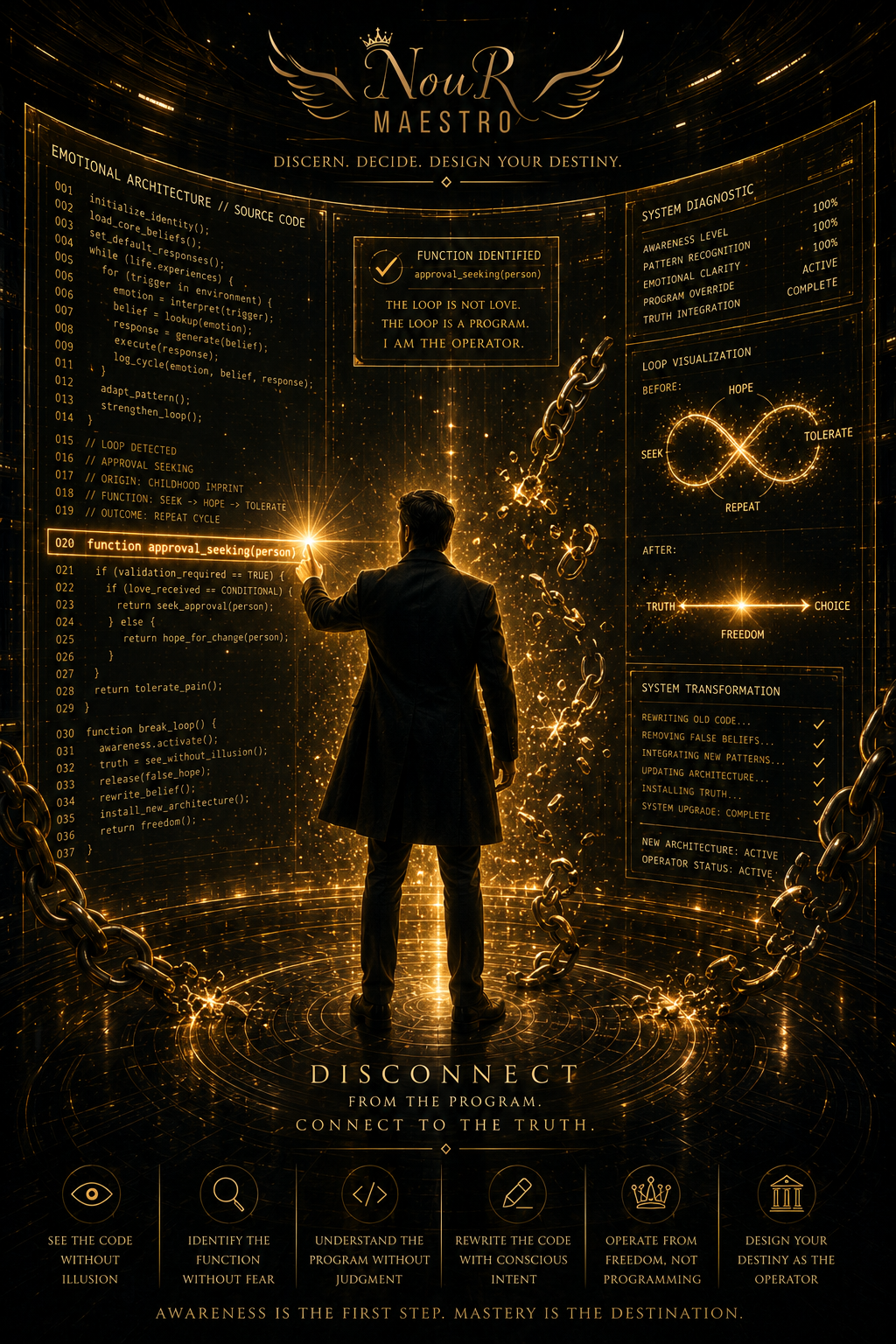
DISCONNECT() — The Sovereign Exit


NOUR MAESTRO · Inner Coding Mastery · The Toxic Code — Part 4
This is the final part of The Toxic Code.
Parts 1, 2, and 3 were diagnostic. They examined the open port, the staying program, and the invisible contract. Each one asked a question about your own architecture — not about the other person, but about what in you made the dynamic possible and persistent.
Part 4 is operational.
DISCONNECT() is not about them. It is not about ending something dramatically, or proving a point, or achieving justice. It is a precise inner operation — the closing of an access point that should have been protected earlier, executed now with the clarity that the previous three parts were building toward.
What follows is the protocol. Not a formula. A framework you apply with judgment, because every situation is specific and no article can account for every variable in your life.
What DISCONNECT() is not.
Before the protocol, the boundaries of the function need to be clear.
DISCONNECT() is not cutting people off as a first response to difficulty. Relationships involve friction. Not every uncomfortable dynamic is a toxic one. Not every difficult person is a threat to your architecture. The Toxic Code series has been specific about what it is examining — persistent patterns of damage, unexamined contracts, open ports being accessed consistently. DISCONNECT() is a response to that — not to ordinary relational difficulty.
DISCONNECT() is not performed. It is not the dramatic exit, the final message, the detailed explanation of everything the other person did wrong. Drama is not closure — it is the loop continuing through a different mechanism. Genuine DISCONNECT() is often quiet. Internal first. External as a consequence of the internal, not as a performance of it.
DISCONNECT() is not always physical separation. The deepest form of disconnection is architectural — withdrawing the access the other person had to the programs that made the dynamic possible. A person can remain in your life — as a family member, a colleague, a necessary presence — while no longer having access to the open port. The relationship continues. The contract is rewritten. The damage stops.
And DISCONNECT() is not permanent by definition. It is appropriate to the situation. Some connections require permanent distance. Others require restructuring. The function does not prescribe the outcome — it executes the withdrawal of harmful access and allows you to assess from a cleaner position what, if anything, remains worth maintaining.
The three levels of DISCONNECT().
Level 1 — Internal disconnection.
This is always first. Always.
Internal disconnection means withdrawing the meaning you have assigned to the other person's behavior — specifically, the meaning that connects their actions to your sense of value, your identity, or your emotional stability.
When they blame — you stop processing the blame as information about yourself.
When they withdraw — you stop reading the withdrawal as evidence of your inadequacy.
When they escalate — you stop feeling responsible for de-escalating what you did not create.
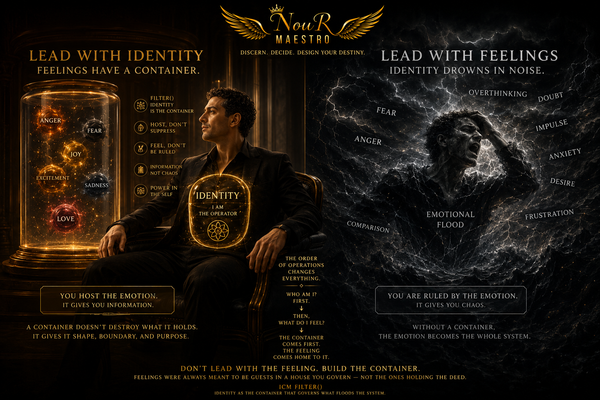
This is not indifference. It is the FILTER() function running at full capacity — receiving the signal without allowing it to install. The behavior continues, possibly. But it no longer has access to the programs it was previously running.
Internal disconnection is the hardest level because it requires the most sustained architectural work. It is not a decision made once. It is a practice executed repeatedly, until the automatic link between their behavior and your self-assessment is genuinely broken rather than merely suppressed.
"Whatever you study, study it with a COLD BLOOD...
and don't worry when you'll learn your lessons,
Emotions won't need invitations."
— NOUR MAESTRO
Study the link between their behavior and your response. With cold blood. Map it precisely. Every time you feel the familiar weight — the guilt, the anxiety, the pull to fix or pursue or absorb — name what just ran. Which program. Which port. Which installed belief just received a signal.
The naming, done consistently, interrupts the automatic execution. Not immediately. Not completely the first time. But gradually, the link weakens. And when it weakens enough, the behavior loses its traction on your system.
That is internal disconnection. It is the foundation without which every other level is unstable.
Level 2 — Relational restructuring.
Once the internal disconnection has genuine traction — once you are no longer running the same programs in response to their behavior — the relationship itself can be restructured.
Restructuring means changing the terms of engagement without necessarily ending the connection. It means no longer fulfilling the invisible contract — no longer being the stable one when stability enables instability, no longer absorbing the blame, no longer carrying the meaning alone.
This will be experienced as change by the other person. Their system expects the old contract. When the old contract stops being fulfilled, there is usually a period of escalation — the system pushing harder for the response it has learned to expect. This escalation is not evidence that you are wrong. It is evidence that the contract was real and the other person's system is registering its dissolution.
How you respond to that escalation determines whether the restructuring holds. If the escalation triggers the old programs — if the guilt of the invisible contract pulls you back into the familiar response — the restructuring collapses. If FILTER() holds, if the internal disconnection is stable enough to maintain through the pressure, the restructuring establishes new terms.
Those new terms may be workable. The relationship, on different terms, may be sustainable. Or the restructuring may reveal that the connection only functioned through the old contract — and without it, there is not enough remaining to justify the continued engagement. Either outcome is information. Neither requires drama.
Level 3 — Physical distance.
When internal disconnection and relational restructuring are insufficient — when proximity itself is the mechanism of recontamination, when the pattern reinstalls faster than the examination can clear it — physical distance becomes necessary.
This is not failure. It is not weakness. It is accurate diagnosis: some systems require space as the primary condition for the inner work to hold.
Physical distance does not require explanation, justification, or the other person's agreement. It requires clarity about what you are doing and why — not for them, but for yourself. Because distance undertaken with clarity is DISCONNECT(). Distance undertaken from fear, from unexamined guilt, or from the exhaustion of having tried everything — without the internal work — is avoidance. And avoidance does not close the port. It simply keeps you far enough from the signal that you cannot hear it.
The port remains open. The next person who produces the same signal will find it.
Closing the port — the work that outlasts the relationship.
This is the part that most people miss — and it is the part that determines whether The Toxic Code series changes anything lasting.
DISCONNECT() from a person does not automatically close the port that gave them access.
The port was built before this person arrived. It will remain open after they leave — available to the next person, the next dynamic, the next relationship that produces the same signal and finds the same entry point.
Closing the port is the work of RE-EVALUATE() and MODIFY() applied to the original installed belief. Not the belief about this person — the belief about yourself that the dynamic was confirming. The worthiness question. The rescuer function. The familiarity calibration. The identity built around the invisible contract.
That work is slower. It is less dramatic than the exit. It does not have a clear endpoint. And it is the only work that actually changes the pattern rather than simply ending its current instance.
This is what Inner Coding Mastery asks of you — not that you remove difficult people from your life, though that may be necessary, but that you examine the architecture that made the connection possible. And then build, carefully and without rushing, the internal structures that make it less necessary.
An internal SAVE() that carries your own sense of value.
A FILTER() that runs before signals install.
A CONNECT() that operates from choice rather than need.
These are not built in the time it takes to read an article. They are built through the daily practice of writing — of running the ICM functions on paper, of examining what arrived and what it activated and what in you responded and why.
The series — complete.
The Toxic Code examined one question across four parts:
Not
"how do I identify toxic people?"
But
"what in my architecture makes the dynamic possible
— and what does it need to run differently?"
Part 1 — The open port you did not know you had.
Part 2 — The program that kept the door open after you knew.
Part 3 — The invisible contract that made leaving feel like betrayal.
Part 4 — The sovereign exit — and the inner work that outlasts it.
The person may be gone. The work continues.
That is not a burden. That is the practice.
You are the master of your page.
Write it consciously — from here.
This article completes The Toxic Code series on nourmaestro.com.
The Toxic Code Part 1: https://www.nourmaestro.com/why-toxic-people-always-find-you-the-open-port-you-dont-know-you-have/
The Toxic Code Part 2: https://www.nourmaestro.com/toxic-environment-why-you-stay-after-you-know-the-program-that-overrides-awareness/
The Toxic Code Part 3: https://www.nourmaestro.com/the-invisible-contracts-why-leaving-feels-like-breaking-a-promise-you-never-made-out-loud/
What is Inner Coding Mastery: https://www.nourmaestro.com/what-is-inner-coding-mastery/
You Are The Master Of Your Page: https://www.nourmaestro.com/you-are-the-master-of-your-page/
— NOUR MAESTRO · Inner Coding Mastery · nourmaestro.com