TOXIC ENVIRONMENT Why You Stay After You Know? -- The Program That Overrides Awareness


NOUR MAESTRO · Inner Coding Mastery · The Toxic Code — Part 2
You already know.
That is the most important thing to establish at the beginning of this article — because everything that follows depends on it being true.
You are not here because you lack information. You are not staying in the difficult relationship, or returning to it, or tolerating it — because nobody told you it was damaging. You know. You have known for some time. You may have known from very early on.
And yet.
This gap — between what you know and what you do — is one of the most painful experiences a human being can have. It produces a specific kind of suffering that is different from ordinary confusion. Confusion is not knowing what is true. This is knowing what is true and finding that the knowledge does not change the behavior.
Most people explain this gap to themselves with one of three stories:
"I love them. That is why I stay."
"I keep hoping they will change."
"I am not strong enough to leave."
All three feel true. None of them are the complete explanation. And none of them, if you examine them honestly with cold blood, actually account for the mechanism.
The complete explanation is architectural.
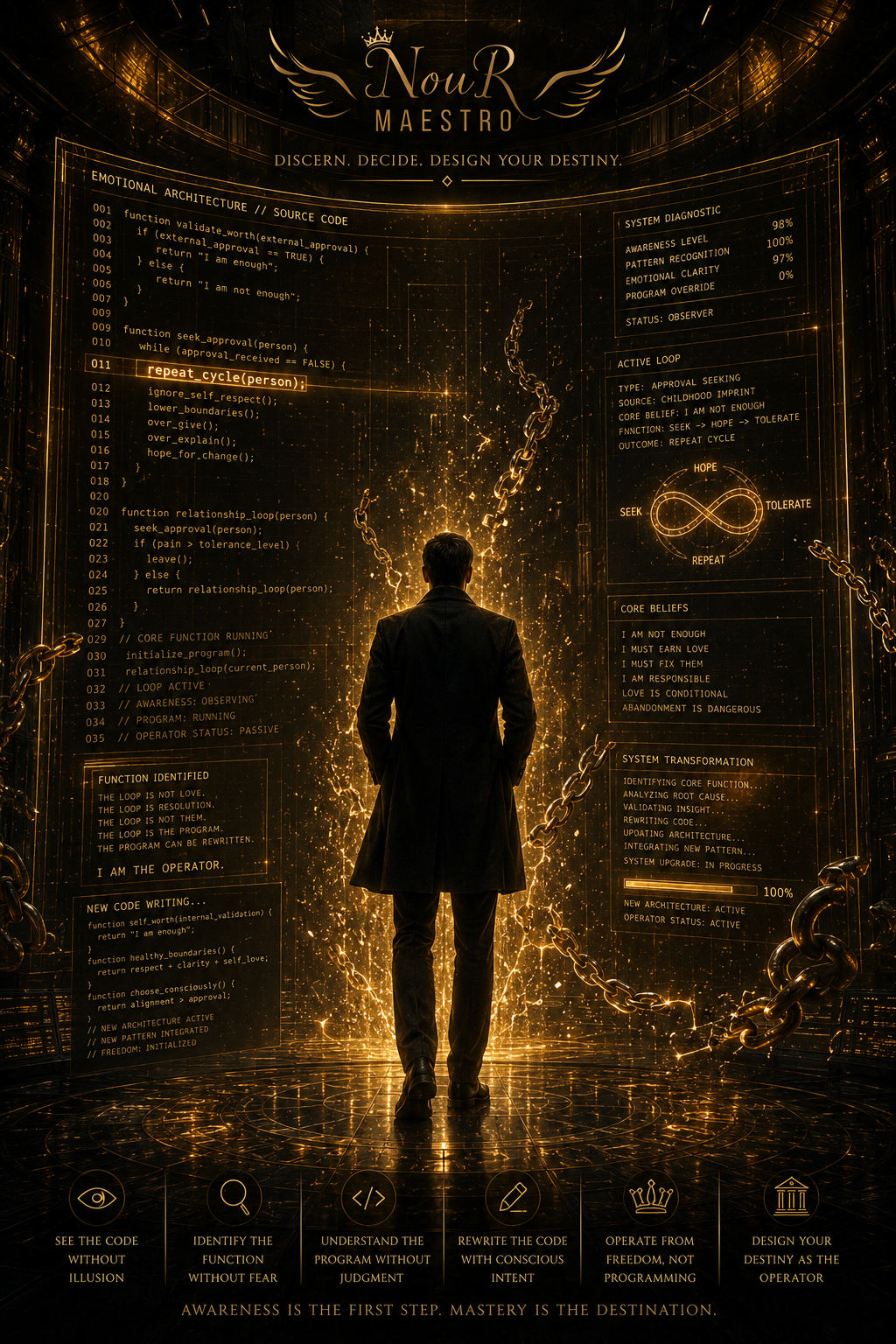
Awareness does not override programs.
-Programs override awareness.
This is the precise claim Part 2 of The Toxic Code is built on — and it is worth sitting with before moving forward.
In Inner Coding Mastery, your behavior is not primarily produced by what you know consciously. It is produced by the programs running in your inner architecture — the installed beliefs, the learned responses, the emotional calibrations that were built before you had the language or the sophistication to examine them.
Consciousness — awareness — operates at a level above these programs. It can observe them. It can name them. It can, with sufficient examination and practice, begin to modify them.
But it cannot simply override them by knowing they are there.
This is why information alone does not produce change. This is why you can read every article about toxic relationships, recognize every pattern described, agree completely with the analysis — and find yourself, two months later, in the same dynamic with the same person or a structurally identical one.
The program is still running.
Awareness is watching the program run.
Watching is not the same as stopping.
What the program is actually running toward.
Here is the question that ANALYZE() requires you to ask — not about the other person, but about yourself:
What do I get from staying?
Not what you consciously want. Not what you would choose if the choice were made from a calm, examined place. But what the program is actually running toward — what function the difficult relationship is serving in your inner architecture.
This question feels uncomfortable because the honest answer is never flattering. But examined with cold blood, it is always precise. And precision is the beginning of change.
The program is usually running toward one of three things:
Toward resolution of an unfinished question.
Many difficult relationships are, at the structural level, attempts to resolve something that was never resolved in an earlier relationship. The parent who was emotionally unavailable. The love that was conditional. The approval that was always almost — but never quite — granted. The difficult person in the present carries enough structural similarity to the original figure that the system believes, on some level beneath conscious reasoning, that this time the resolution will come. That this time the approval will be granted. That this time the love will be unconditional. The system is not deluded. It is running a program that was built around an unfinished loop — and it will keep running that loop, in different relationships, until the loop is identified and closed internally rather than chased externally.
Toward confirmation of an installed belief.
This is harder to accept — but it is one of the most common mechanisms. If the deepest installed belief is "I am not enough" — then a relationship that confirms that belief, however painfully, is more familiar than one that challenges it. Familiarity is not comfort. But it is recognizable. And the system, under stress, reaches for what is recognizable before it reaches for what is healthy. The person who confirms "you are not enough" through their behavior is not damaging you despite your installed belief. They are, at the architectural level, confirming it. And confirmation — even painful confirmation — satisfies something in the system that needs the belief to be real, because if the belief is real, the world makes sense in the way the system learned to make sense of it.
Toward the preservation of identity.
Some programs are so deeply installed that they have become indistinguishable from the self. "I am a loyal person." "I do not give up on people." "I am someone who sees the best in others." These are not bad values — but they can become programs that run even when they are producing damage. Because abandoning the program feels like abandoning the identity. Leaving the relationship feels like becoming someone you do not recognize. Staying, even at significant cost, preserves a sense of self that feels more essential than the wellbeing it is costing.
"Whatever you study, study it with a COLD BLOOD...
and don't worry when you'll learn your lessons,
Emotions won't need invitations."
— NOUR MAESTRO
Study what the program is running toward.
Not with judgment — with cold blood.
Not to condemn yourself for staying — to understand the precise mechanism that made staying feel necessary.
When the mechanism is understood — not just named, but genuinely examined at its root — the emotion arrives on its own. The grief of recognizing what you were actually chasing. The clarity of seeing the unfinished loop for what it is. The specific relief of understanding that the behavior was never about weakness.
It was about a program running a function that had not yet been updated.
Why "I will change when they change" is a loop, not a plan.
One of the most common programs running in difficult relationships is the conditional exit:
"I will leave when things get bad enough."
"I will change when they show me they can change."
"I will stop trying when I have tried everything."
These feel like rational positions. They are actually loops.
A loop in ICM is a program with no natural exit condition — one that keeps generating the same output because the condition that would terminate it is defined in a way that can never be met.
"Bad enough" is not a fixed point. It moves. Every time the threshold is reached, the program resets and draws the line somewhere further. Because the loop is not actually tracking external behavior — it is tracking the internal need that the relationship is serving. And that need does not get satisfied by the other person getting worse. It gets satisfied, temporarily, by the next cycle of hope — the next moment of connection, the next sign of change, the next period of calm that seems to promise the resolution is finally coming.
This is not manipulation by the other person. It is a loop running in your own system — one that the dynamic of the relationship activates and sustains.
LOOP() in ICM does one thing: it makes the loop visible. It names the condition that would theoretically end it — and then examines whether that condition can ever actually be met from outside.
The answer, in most cases, is no.
The unfinished question cannot be resolved by the person who resembles its original source.
The installed belief cannot be disproven by someone confirming it.
The identity built around loyalty cannot be preserved by the sacrifice of everything loyalty is supposed to protect.
The exit condition must be generated internally
— not waited for externally.
The moment awareness becomes power.
There is a specific moment in the examination of this pattern where something shifts.
It is not the moment you understand it intellectually. That moment can come and go without producing any change at all — because understanding without architectural examination is just a more sophisticated story about the same loop.
The moment that matters is when you can see — clearly, specifically, without self-deception — the precise function the difficult relationship is serving. When you can name the unfinished question it is trying to resolve, or the installed belief it is confirming, or the identity it is preserving.
Not approximately. Precisely.
That precision is what transforms awareness from a spectator into an operator.
Because once you can see the function — once you understand what the program is running toward — you can begin building that function internally. You can begin closing the loop from the inside rather than chasing its resolution from the outside. You can begin examining the installed belief directly rather than seeking its disproof through other people's behavior.
The relationship does not have to end for this to begin.
But you, inside it, will be running a different program.
And a different program produces different outputs — in what you tolerate, in what you ask for, in what you accept as the condition for your continued presence.
That is not the end of the pattern.
But it is the beginning of something that is.

What Part 3 examines.
The Toxic Code continues with the invisible contracts — the unspoken agreements that both people enter into in a difficult relationship, and why breaking them feels like a betrayal even when they were never consciously made.
Part 1 examined the open port that allows access.
Part 2 examined the program that keeps the door open after you know.
Part 3 examines what was silently agreed to — and why leaving feels like breaking a promise you never made out loud.
This article is part of the ICM series on nourmaestro.com.
What is Inner Coding Mastery: https://www.nourmaestro.com/what-is-inner-coding-mastery/
The Toxic Code Part 1 — Why Toxic People Always Find You: https://www.nourmaestro.com/why-toxic-people-always-find-you-the-open-port-you-dont-know-you-have/
Misery Is The Price Of Ignorance: https://www.nourmaestro.com/misery-is-the-price-of-ignorance/
They Don't Tell You They're Bleeding: https://www.nourmaestro.com/they-dont-tell-you-theyre-bleeding-they-just-make-sure-you-feel-the-wound/
— NOUR MAESTRO · Inner Coding Mastery · nourmaestro.com