They Don't Tell You They're Bleeding. They Just Make Sure You Feel The Wound.


There is a behavior so common it has become invisible.
Someone in your life is struggling. They are carrying pain — real pain, genuine pain, the weight of something unresolved inside their system. But instead of saying "I am struggling" — instead of naming what is happening in their inner world — they transmit it.
They blame. They project. They pull dark moods into the room like weather. They find what is wrong with you, with the situation, with the day. They replay the same grievances. They manufacture tension from nothing. They make you feel responsible for a discomfort they have never named and you never caused.
You absorb it. You feel it in your body before you can name it. You find yourself heavier, more anxious, more uncertain — and you do not know exactly why.
This is not a personality conflict.
This is a transmission.
And if you do not understand what is actually happening — your system will process their virus as your own data.
The machine that cannot speak its warning light.
Consider what happens when a car needs oil.
The engine does not explain the problem. It does not say: "My lubrication levels are critically low and I am experiencing significant mechanical stress." It sends a signal — a warning light. A sound. A vibration. Something that communicates distress without language, without precision, without clarity about what is actually wrong.
Now consider the human being who has never learned to communicate their inner malaise directly.
They have the same warning light. The same internal signal that something is wrong. But they do not say: "I am in pain. I need something. I am carrying something I do not know how to carry."
They transmit the signal the only way their system knows how — outward, through behavior. Through dark moods that fill the room. Through blame that lands on whoever is closest. Through stories that cast you as the source of a discomfort you did not create.
They are not attacking you. They are running a malfunction signal with no language to make it precise.
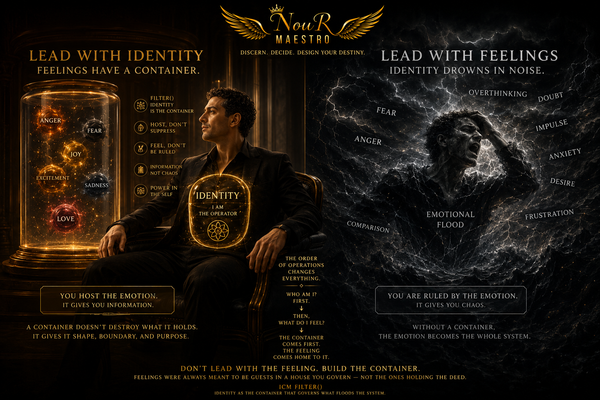
The problem is that their imprecise signal — if you do not FILTER() it — becomes your data.
Step One: FILTER() — Is this mine or theirs?

"Whatever you study,
study it with a COLD BLOOD."
-NOUR MAESTRO
Before anything else — before you analyze, before you decide, before you respond — FILTER() asks one question:
Does this belong to me, or was it transmitted?
Cold blood. Not coldness of heart — precision of mind. The ability to receive a signal without immediately becoming it. To feel the weight of someone's transmitted pain without registering it as your own malfunction.
Most people fail at this step not because they are weak but because the transmission arrives before the awareness. The mood has already entered. The blame has already landed. The heaviness is already in the body — and by the time the mind catches up, it is already processing the foreign data as local truth.
FILTER() is the pause you install between reception and processing.
It asks: whose signal is this?
The answer changes everything that follows.
When FILTER() runs correctly, you do not absorb the transmission. You receive it — you feel it — but you flag it immediately as external input rather than internal truth. Their bleeding does not become your wound. Their unprocessed pain does not become your operating data.
This is not denial. It is sovereignty over your own system's input.
Step Two: ANALYZE() — Study it with cold blood.
Once FILTER() has identified the signal as external — once you know this is their transmission, not your truth — ANALYZE() examines it precisely.
"Whatever you study, study it with a COLD BLOOD."
Cold blood here is the methodology. Not emotional distance — operational clarity. The same clarity a surgeon brings to what is on the table. They are not indifferent to the patient. But the scalpel requires a steady hand. Emotion without precision is not compassion. It is contamination.
ANALYZE() asks three questions about the transmission:
What are they actually communicating — beneath the behavior?
The blame is not about you. The dark mood did not originate in this room. The grievance is older than this conversation. What is the real signal beneath the transmitted one? A person who blames constantly is communicating: I cannot locate the source of my pain, so I assign it to whatever is nearest. A person who loops the same story is communicating: I have an unprocessed event that I have no tools to examine. This is diagnostic information — not about you, but about them.
What program are they running?
Every transmission has an origin. The person who learned early that expressing vulnerability meant punishment learned instead to transmit pain through behavior. The person whose environment never modeled emotional language developed no vocabulary for it. Their behavior is not their character — it is their installed program responding to internal pressure the only way it knows how. ANALYZE() sees the program. Not the person as the program, but the program running through the person.
What is the effect on your system?
Where did this land in you? In your sense of value — do you feel suddenly less capable, less worthy? In your sense of safety — do you feel suddenly that something is wrong, that you must fix something, that you are responsible? The location in your system where the transmission lands is diagnostic information about your own architecture — the open port through which external signals are still entering without examination.
Step Three: DISCONNECT() — Remove the access.
DISCONNECT() is the most misunderstood function in Inner Coding Mastery.
It is not about ending relationships. It is not about walls or coldness or abandonment. It is about removing access — specifically, removing the access a transmission has to your operating system.
There are three levels of DISCONNECT():
Level 1 — Disconnect the transmission from your identity.
Their blame does not define your value. Their dark mood does not determine your emotional state. Their unprocessed pain does not become your responsibility. This is the most fundamental disconnection — severing the automatic link between what they transmit and what you conclude about yourself.
Level 2 — Disconnect the loop.
When someone is running the historical loop — returning compulsively to the same grievance, the same evidence of wrongness — you do not have to be the audience that keeps the loop running. Every time you engage fully with the loop — absorb it, respond to it, try to fix it — you provide the energy that keeps it cycling. DISCONNECT() here means withdrawing that energy without withdrawing from the person. You stay present. You do not feed the loop.
Level 3 — Disconnect physically when necessary.
When the transmission is consistent, heavy, and resistant to the first two levels — when proximity itself is the mechanism of contamination — DISCONNECT() authorizes physical distance. Not as punishment. Not as rejection. As system protection. Some transmissions require space as the primary filter. This is not coldness. This is the recognition that you cannot maintain your own architecture while living inside someone else's malfunction signal.
The compassion that does not contaminate.
This needs to be said precisely — because none of the above is about abandoning people who are suffering.
The person transmitting their misery is in genuine pain. The behavior is their unprocessed interior finding the only exit it knows. Understanding this is not optional — it is required for ANALYZE() to function with accuracy rather than judgment.
But genuine compassion is not absorption.
It is the capacity to be present with someone's pain without running their pain as your own program. To see the transmission clearly — its source, its mechanism, its actual message — without becoming its destination.
The most sovereign thing you can offer someone who transmits their misery is not to receive it on their terms. But to remain so clearly yourself — so unmoved in your own architecture — that your presence itself becomes a different kind of signal.
Not: I will absorb your pain so you feel better.
But: I am here. I am stable. I will not become your wound.
That stability — that refusal to be contaminated while remaining genuinely present — is one of the highest applications of Inner Coding Mastery in relationship.
It is mastery that serves both people simultaneously.
The protocol — complete sequence.
RECEIVE the transmission
       ↓
FILTER()  →  Is this mine or theirs?
             Flag it as external before it installs
       ↓
ANALYZE() →  Study it with cold blood
             What are they communicating beneath
             the behavior? What program is running?
             Where did this land in my system?
       ↓
DISCONNECT() →  Remove the access
                From your identity — Level 1
                From the loop — Level 2
                From proximity if necessary — Level 3
       ↓
RETURN to your own architecture
Write. Examine what arrived.
Confirm what is yours.
Your inner world is not a public space.
"Whatever you study,
study it with a COLD BLOOD."
— NOUR MAESTRO

Study their transmission — precisely, without judgment, without absorption.
Study your own response — where it landed, what it activated, what it revealed about your own architecture.
Study the difference — between what is theirs and what is yours.
That study, conducted with cold blood, is the entire practice.
They don't tell you they're bleeding.
They make sure you feel the wound.
Your only protection — and your deepest sovereignty — is knowing whose blood it is before you treat it as your own.
This article is part of the ICM series on nourmaestro.com.
What is Inner Coding Mastery: https://www.nourmaestro.com/what-is-inner-coding-mastery/
The FILTER Function: https://www.nourmaestro.com/inner-coding-mastery/
You Are The Master Of Your Page: https://www.nourmaestro.com/you-are-the-master-of-your-page/
Misery Is The Price Of Ignorance: https://www.nourmaestro.com/misery-is-the-price-of-ignorance/
Sovereignty Is Your Crown: https://www.nourmaestro.com/sovereignty-is-your-crown-dependency-is-your-abdication/
— NOUR MAESTRO · Inner Coding Mastery · nourmaestro.com